
Today, November 11, 2025, is Wildmind’s 25th birthday. The Wildmind website is celebrating its 25th anniversary. As far as I know, this was the first website where anyone could learn meditation. I’m happy and happy that this website is still up and running after 25 years.
Now it has happened.
Master’s degree in Buddhism?
Around 1997, I met a professor of Buddhist studies named Alan Ponberg, who was my alter ego as Dharmachari Saramati. He was a member of the Triratna Buddhist sect like me. We met at a Buddhist convention and he told me he had the funds to get a teaching assistant position. Successful applicants will have their master’s degree tuition fees covered by the university. Living in the Rocky Mountains while studying Buddhism for three years and getting paid for it seemed like a pretty good deal. Additionally, Missoula, home to UM, has the Triratna Buddhist Center, which I was able to attend.
As it happened, the Department of Buddhism was made up entirely of Saramati, and it was impossible to get a master’s degree purely in Buddhism, so doing some sort of interdisciplinary master’s degree was the best option. This involves studying both Buddhism and its second comparable subject, with a particular focus on the overlap between the two. At first I thought of studying Buddhism and Japanese, but at that time my interest in Zen Buddhism did not last long. Saramati informed me that, unfortunately, the Zen scriptures were written in Chinese, and that I probably wouldn’t be able to learn enough Chinese to study the Zen scriptures during the three years of my master’s program.
look back at your background
Back to square one. I thought about what I wanted to do with my life. At the time, I had been in college for six years. I started to think that a master’s degree is just about acquiring knowledge and skills that have little practical value in life. My first degree was in Veterinary Medicine at the University of Glasgow, graduating in 1984. I became a Buddhist when I was a veterinary student. Unfortunately, I have come to the conclusion that I should not become a veterinarian. It turns out that the meditation practice I was doing made me emotionally sensitive and having to kill animals was traumatic and caused me terrible nightmares. However, I ended up graduating.
Then I worked in a printing business with other Buddhists and gave myself time to think about what to do with my life. I also did various volunteer activities, which was fun. I taught basic reading and writing skills to illiterate adults. One evening a week, I helped an immigrant teenage boy with his schoolwork (his father had abandoned the family and his mother spoke little English). I also volunteered at an adventure playground for children with mental and physical handicaps. All of this was so enriching that I applied and was accepted to a one-year graduate course in community education. I spent a difficult year in small classes with 11 other students (including Gary Lewis, now a famous actor, and Shona Robison, who was at one time Deputy First Minister of Scotland).
I learned many skills in Community Education Worker and worked in that field for several years. However, I left my job to go on a four-month ordination trip to Spain, where I joined the Triratna Order and became a Bodhi Paksha.
When I returned to Scotland, there were no community education jobs available, but there was a vacancy as manager of the Danacosa Retreat Center in the Scottish Highlands. Danakosa was fairly new at the time. My previous manager left after a year and wasn’t organized enough to have a filing cabinet.
Buddhism and business
I gained many skills, including teaching experience and running a retreat center, which was not that different from running a small education center for single parents that I founded as a community education worker.
Let’s go back to the master’s program. I realized that I always loved helping people and building things. These are things I have done through volunteer work, community education, and as a manager at Danacosa. I thought UM had an entrepreneurship program, and it turns out they do. Therefore, it was decided that the interdisciplinary master’s program would study the overlap between Buddhism, business, and what is traditionally called the right livelihood. This overlap required a practical element. At first we thought we could work with an existing Buddhist business (restaurant) in Missoula, but that didn’t seem possible.
inspiration
I remember, I think it was 1999 or early 2000, I had to wait for an appointment with someone who was going to be late. As I waited, inspiration suddenly struck. I’ve taught meditation a lot, and from what people have told me, they seem to be good at it. I thought, what if I started a website where people could learn to meditate? People have already learned meditation from books. The website may have readings. People have already learned meditation from cassette tapes. Recordings may remain on the website.

You have to keep in mind that this was less than 10 years after the World Wide Web was publicly available. At this point I had only been online for seven years. Although there were places on the Internet where you could look up meditation class times and locations and read Buddhist scriptures, you couldn’t learn meditation online.
Initially, my idea was just to get free resources, but then a friend of mine, Pat Lawler, who is also a Buddhist and a very successful businessman, asked me if I could run a course and make a living from it. I thought maybe I could do it. Pat is a very generous person and gave me the funds so I could buy a domain name and start a website.
develop ideas
At business school, I entered this idea into a business plan competition and won second place. In the philosophy department, my professor and I submitted a grant application to the American Council of Learned Societies to test whether a meditation course could be delivered online. Your application was successful. I wrote the proposal and my professor kept most of the money, but the money left over was enough to support me over the summer writing content for the website. ) I ran this course in the fall of 2000 and it went well. The course was run on UM’s course management system, so it wasn’t on the Wildmind website.
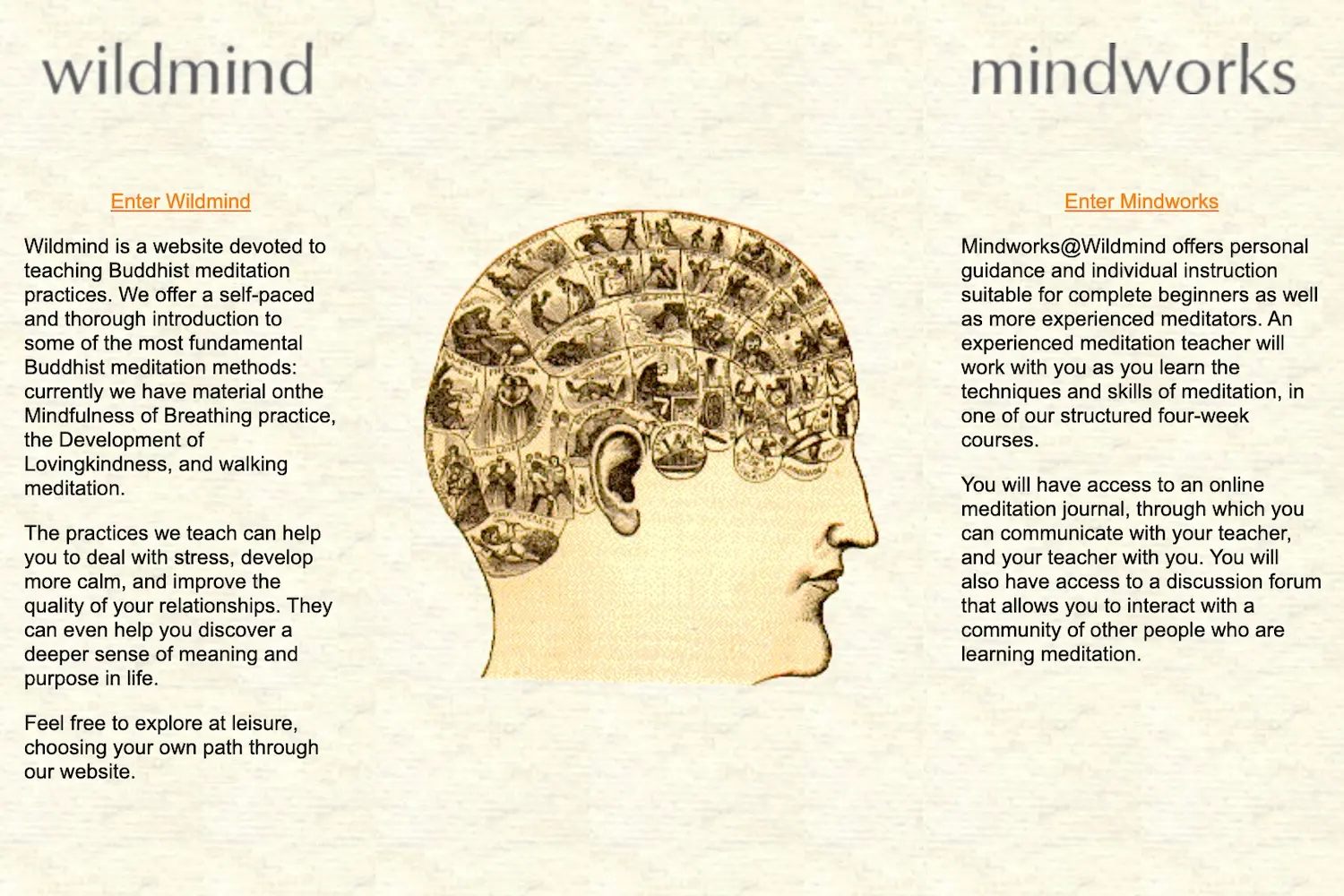
The actual website was born with the help of Heidi Harting-Rex, a local web designer who helped me turn the course materials I developed into the Wildmind website. (I also enlisted the help of my old friend Roger Higham from Edinburgh.) The header image for this article is a screenshot from the Wayback Machine’s first snapshot of the site on February 1, 2001, when the site was only three months old. The first course (operated under the name Mindworks) was conducted in the spring of 2001.
25 years later
Things have evolved a lot since then. Along the way, I realized that community is important. And now we have a small but thriving WildMind community of about 400 people who donate varying amounts of money each month to support my exploration and teaching of meditation.
After 25 years, we are still doing well financially. Sometimes I have to do fundraisers for my community and website fans. I’ve almost given up twice and once wrote a letter explaining why I had to give up teaching meditation. (I was trying to apply for a social media marketing job at a local company.)
In the meantime, if you would like to support this ad-free site, please feel free to donate. Or you can become part of the community by becoming one of Wildmind’s sponsors.
I have to say that I am lucky to have had the opportunity to spend so much time practicing, contemplating, teaching, discussing, and writing about meditation, even though it has been challenging. It was very rewarding. It’s also reassuring to know that my guided meditations have been listened to by literally millions of people, and that I have several articles that have been read by nearly a million people each. I’m still hanging in there! And so is Wild Mind. I hope this site continues to exist for many years to come and continues to provide meditation advice and guidance to millions more people after I’m gone.