What happened when the first randomized controlled trials matched ultra-processed foods for calorie, carbohydrate, fat, and fiber content?
In the United States, “junk food” is often used to refer to less-healthy foods such as candy, ice cream, and potato chips, but the lack of a consistent definition led nutrition researchers to come up with the concept of ultra-processed foods.
The term “ultra-processed food,” if you want to call it that, refers to industrial formulations that are typically found on long lists of ingredients. These ingredients are not typically listed in any cookbook, including salt, sugar, and fat, as well as various flavors, sweeteners, colorants, emulsifiers, and other additives used to imitate real foods or mask undesirable qualities in the final product. This roughly corresponds to my idea about “red light foods” in a traffic light system. Ideally, you should maximize your intake of green light foods, minimize yellow light foods, and avoid red light foods. In fact, most of what people eat are red-light foods, such as soda, ice cream, candy, cake, most breads and breakfast cereals, TV dinner-type prepared products, chicken nuggets, fish sticks, sausages, hamburgers, and hot dogs. Ultra-processed foods have increased dramatically. In fact, the food supply of the United States is controlled by them. More than 200,000 products were evaluated and 71% were classified as ultra-processed.
And of course, it’s not just found in grocery stores. Sugary drinks and processed junk are ubiquitous, even in non-food retail stores, and signals to consume calorie-dense but nutrient-poor products are pervasive. As Coca-Cola’s former chief executive said, soda should be kept “within arm’s reach.” The major candy brand boasted, “You can find it everywhere: grocery stores and supermarkets, gas stations and chiropractor offices, bowling alleys and grocery stores. Like I said, we’re not sorry.”
So that’s all for today. What percentage of the food consumed by children and teens in the United States is categorized as junk? Incredibly, between 56% and 70% of what children and teens eat each day is junk. But kids will be kids, right? Overall, more than half of the calories consumed in the United States are junk calories. In fact, ultra-processed foods consistently account for more than 50% of dietary calorie intake in high-income countries around the world. It’s no wonder that unhealthy diets are humanity’s biggest killer and the leading risk factor for death worldwide, as seen below and at 2 minutes 25 seconds of my video “Testing Ultra-Processed Junk Food.”
What kind of health damage does it cause? The biological effects of modern foods have been studied in rats, which have been shown to suffer from dramatic weight gain, inflammation, and cognitive and metabolic abnormalities. And just as ultra-processed foods became popular, bulimia was recognized as a new eating disorder and grew to become the most common form of eating disorder. And unsurprisingly, binge drinking turns out to be 100% ultra-processed. That’s not surprising either. These foods are designed so that you can’t just eat one. People don’t tend to binge eat broccoli.
Nine out of 10 studies found that eating ultra-processed foods was associated with negative health outcomes, including not only obesity but also cancer, cardiovascular disease, type 2 diabetes, irritable bowel syndrome, depression, frailty, and all-cause mortality (shortened lifespan). Studies on young people have added asthma to the list and also reported an increase in DNA damage. No studies have reported an association between ultra-processed foods and beneficial health outcomes.
In contrast, people who consume less meat, higher fiber intake, and minimally processed foods have far fewer chronic diseases, lower obesity rates, and live longer, disease-free lives. However, most of the findings are based on observational studies. We won’t know if ultra-processed foods themselves are the culprit until we test them.
In the first randomized controlled trial of ultra-processed foods, 20 people were essentially confined to a hospital ward and forced to consume both ultra-processed and unprocessed foods for 14 days each. Here’s the kicker. Meals are designed to provide the same calories, sugar, fiber, fat, and macronutrients. why? In response to the criticism, manufacturers are now offering to reformulate their products, leaving them ultra-processed but with tweaks such as adding fiber and reducing sugar, fat and salt. So the researchers wanted to determine the effects of ultra-processing by giving study participants the same amount of calories, sugar, fat, fiber, carbohydrates, and protein in each of the two meals. So, for example, for breakfast during ultra-processed week, participants would get cheerios and muffins, or egg and cheese muffins with turkey bacon and orange juice. When it came time for a less processed breakfast, people ate oatmeal with blueberries or almonds, for example. The meals contained the same amount of sugar and fat overall, but the unprocessed options came in the form of more whole foods. For lunch, those in the ultra-processed diet group might eat a turkey sandwich with fat-free Greek yogurt, canned peaches, baked potato chips, and sugar-free Crystal Light lemonade. On the other hand, the unprocessed diet group might eat a Southwestern entrée salad with black beans, carrots, corn, avocado, nuts and grapes or apples. They were provided with the same number of calories and given instructions to eat as much or as little as they wanted.
So what happened? As you can see below and at 5:31 of my video, on the ultra-processed diet, people ate about 500 more calories per day, and unsurprisingly, they gained about 2 pounds on the processed diet and aggressively lost 2 pounds on the low-processed diet.
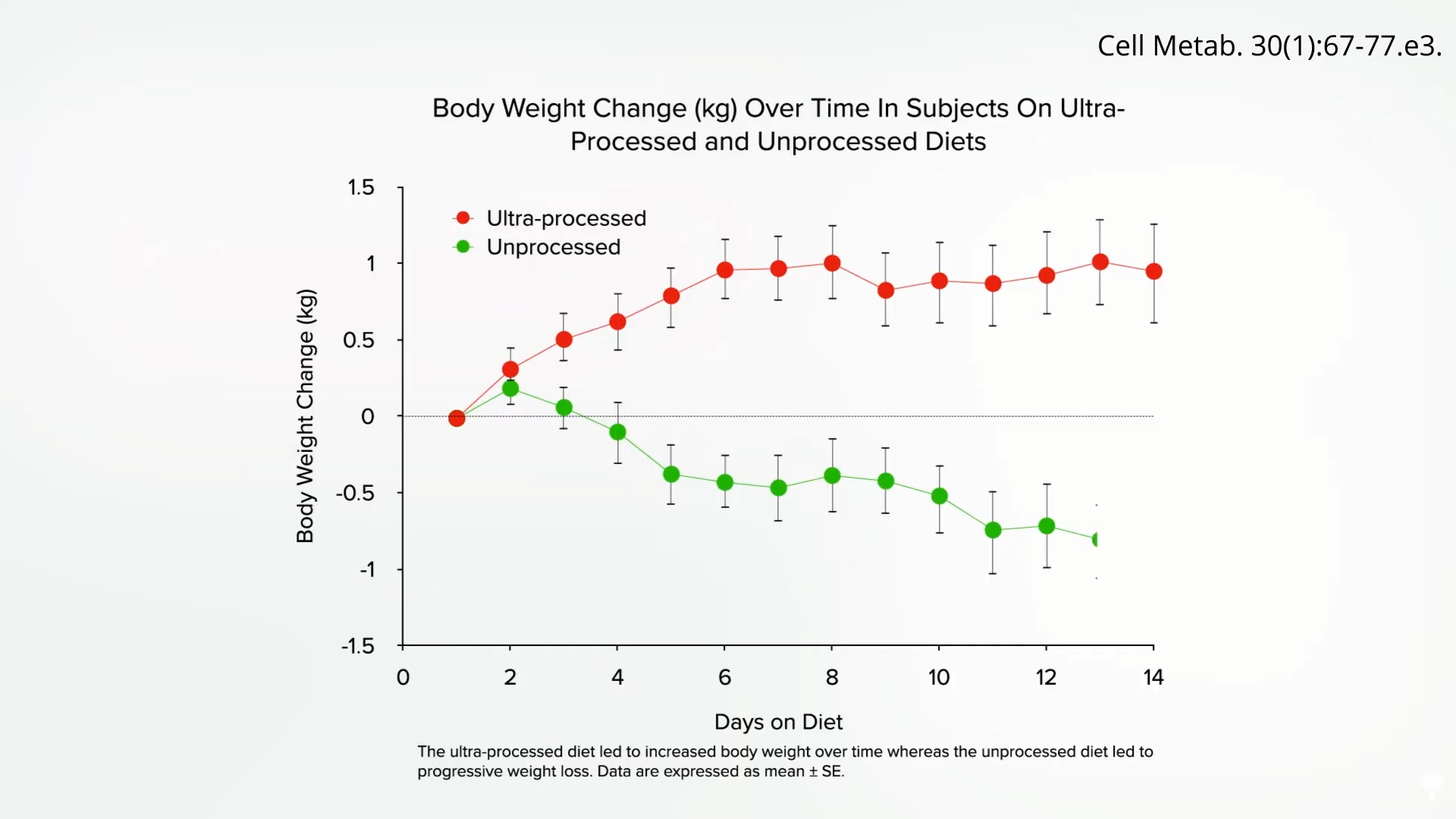
In other words, the problem was not just the nutritional imbalance of ultra-processed foods. Simply making adjustments won’t magically make you healthier, but the industry would rather. Reformulation has been called a “discreet strategy” that creates “the prospect of improving nutrition without changing the diet.” But this study shows that it may be better to limit your intake of ultra-processed foods altogether.
Why does the industry love them so much? They’re made with extremely cheap ingredients, including taxpayer-subsidized corn syrup, resulting in huge profits for companies. But at what cost? The food industry generates more than $1 trillion each year, but most of our health care spending goes toward treating chronic diseases such as diabetes and heart disease that are exacerbated by the same foods. So you could argue that “the food industry loses three times what it produces.” The food industry claims that telling people to avoid ultra-processed foods these days is “unrealistic” given societal time constraints and the difficulty of preparing meals, but this may just be a tacit endorsement of the same propaganda and disinformation campaigns that the processed food industry has used to feed families for decades. If you think that health foods are not convenient, you have never encountered an apple.
This was a response to Dr. Lustig’s paper on processed food as a failed experiment, in which he stated, “One-third of American mothers today don’t even know what real food is or how to cook it. They and their children are destined to remain hostages to the processed food industry.” I don’t like to blame his mother, but I appreciate his prescription. “The only recourse is real food that is low in sugar and high in fiber.” We need to start thinking outside the box.
doctor’s note
It’s no surprise that processed foods have a negative impact on our health. Learn about the role of processed foods in the obesity epidemic. Is there a solution? Yes. Avoid processed foods that are high in calories.
This is the third video in a series about junk food. If you missed the first two, check out “Do Healthy Fast Food Options Lead to Healthier Choices?” How we won the battle to ban trans fats.
We mentioned a signaling system for choosing the healthiest foods. For more information, see Eating at Traffic Lights: Green is Go, Red is Stop.