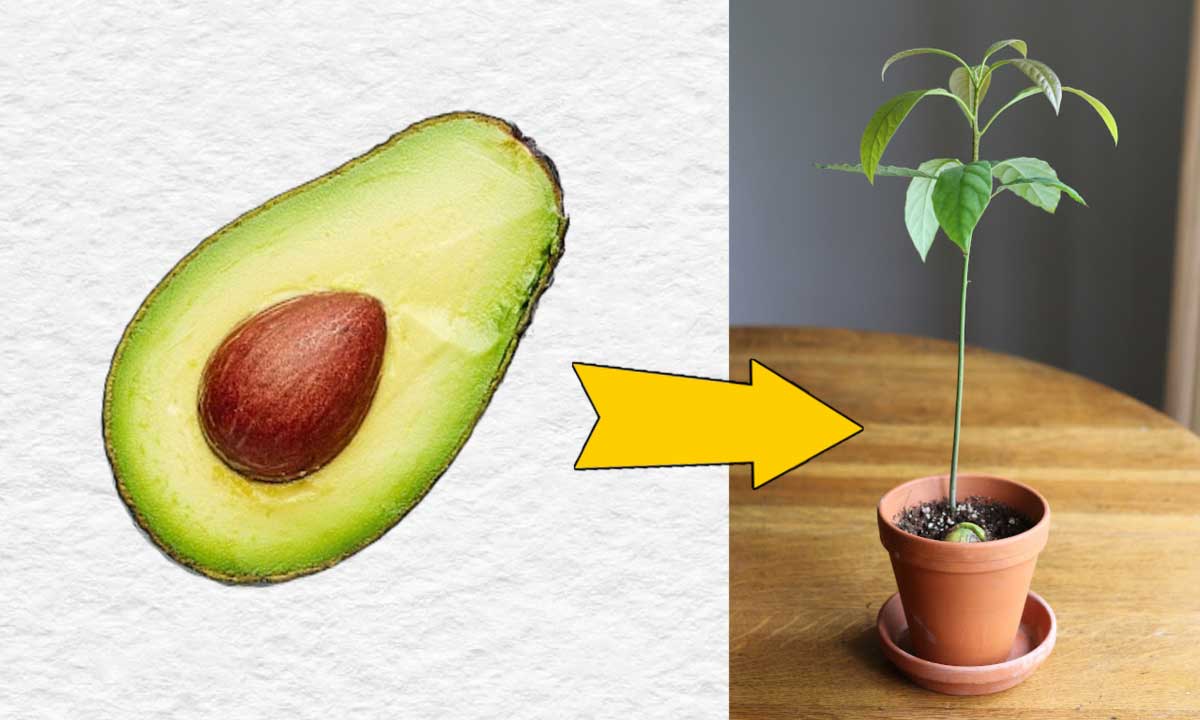
Forget the toothpicks! Try this easy and hassle-free method of rooting an avocado seed. It takes almost no effort and you can see exactly which ones will germinate before you pot them.
Once you have established your seeds, use this guide to growing avocado plants as houseplants.
grow avocado seeds

Forget toothpicks and water! And don’t worry about those plastic gizmos on Amazon that suspend seeds above water. This method (below) is more effective. You can germinate avocado seeds with just a few household items.
I tested this simple method on many grocery store avocados and the germination rate was very good.
I don’t like the toothpick method because it’s messy, time-consuming, the seeds can rot, and it’s not reliable.
You can also germinate avocado seeds by placing them directly into moist potting mix, but this can also be hit or miss.
Using the method described below, you can know in advance whether your seeds will actually grow before you plant them.
Before you start
A little reality check. Chances are your avocado won’t bear fruit, or if it does, it may take years and not produce good fruit.
Growing an avocado from seed is the slowest and least reliable way to get a real (identical to the parent) fruit.
Commercial growers use grafting methods to ensure quality and quantity of fruit, which is not really possible for home growers.
However, starting plants from seeds (also known as “pits”) is an easy way to grow free houseplants. Even if it does bear fruit, it could take eight to 20 years. Grafted avocados will bear fruit in 2 to 3 years.
The actual pollination process is quite unusual and interesting, so it’s worth reading further if you’re interested.
So start saving these pits and grow.
There is an option to save the steps at the bottom of the page.
You can also grow mangoes from supermarket fruit using this same method.
Learn how to germinate seeds, plant them, and care for them as houseplants.
Easy way to grow avocado seeds

It takes 4 to 6 weeks for an avocado seed to root and be ready for planting.
Prepare the seeds
You will need one ripe avocado, a paper towel, and a plastic bag.

Remove the pit (seed) from a fresh ripe avocado. Avoid using the knife where it could damage the seeds.
Using a soft brush or cloth, gently wash the seeds under warm running water, making sure all pulp is removed.

Wrap the seeds in a damp (non-drip) paper towel or tea towel.
Store in a food-grade plastic bag (do not close the zipper) in a dark cupboard at room temperature (approximately 21°C).
If you have more than one, start them all at once to increase your odds.
watch growth
Check the seeds every four days. I put a reminder on my phone’s calendar so I don’t forget.
At first, just make sure the paper towel stays damp. After a few weeks, you will start to see signs of germination.

When a seed germinates, it gradually splits, revealing deep fissures, and eventually roots grow from deep within the seed.
Do not break up the seeds. The body of the seed nourishes the growing roots, but the roots are delicate so handle them carefully and avoid breaking them.
The following photo shows an avocado pit after it has been sitting on a damp paper towel for a month.

Notice how the germination rates differ.
Some people are just starting out. Both are doing well. One is that they refuse to budge.
Wait a few more weeks for these and then plant the strongest ones.
It’s helpful to know that no two sprouted avocado seeds are exactly alike. There are so many crazy variations!
Don’t worry if the roots are growing in different directions. The factory will sort things out later.
Once the roots are 3 inches long (there may be more than one root), the seeds are ready to be planted in a pot.
Keep reading for tips on how to plant germinated seeds.

How to plant a sprouted avocado seed
supplies
Avocados prefer good drainage, so you can also amend the potting mix with perlite or sand if necessary.
How to distinguish between top and bottom

When planting germinated seeds, it is helpful to know from the bottom to the top so you can place them with the bottom facing down and the top facing up.
Some avocado seeds are very round, so it’s not obvious, but there are some clues.
The top is (usually) tapered or pointed. The bottom is wide and flat, often with rounded scale-like markings. Roots (usually) grow from the bottom, but not always.
If you really can’t tell, don’t worry. Just follow the planting instructions and the plants will plant themselves.
plant germinated seeds
To plant, fill the pot halfway with potting mix and gently place the seeds inside the pot.
Handle carefully to avoid breaking the roots.
If the root (or roots) is much longer than the pot size, you run the risk of breaking the roots while trying to fit everything into the pot during the potting process.
If you don’t have access to a larger pot, you can cut back as needed, but be careful not to overdo it. Use sharp scissors cleaned with rubbing alcohol or a bleach solution (4 teaspoons of bleach per quart of water for at least 1 minute).
Root pruning (trimming) is also said to help produce bushy rather than tall, leggy plants, but I couldn’t find any research to confirm that.
Sometimes the roots are growing in different directions, and it may not be possible to distinguish between roots and shoots. If this is the case, make sure to keep all roots below the soil surface. The plant will know what to do from there.
While stabilizing the seeds, gently press down on the potting mix, adding more if needed, leaving the top 1 inch of the seeds above the soil level. A stem will grow if it doesn’t already have one.

Give it water (distilled water at room temperature) until it is moist but not wet. Replenish potting mix as needed.
Place it in a warm, draft-free location with strong indirect light.
As it grows, leaves will appear.


take care of avocado
Save instructions
Epress of Dirt
How to grow an avocado from seed
This article contains basic growing tips.

A download link will be sent to your email.
Joining our free newsletter list is an option at checkout.
growth tips
Avocado |Genus: Persea
tropical plants
• Light: Full indirect solar
• Humidity: medium to high
• Soil: Do not let it dry out.
• Fertilizer: Fertilizer for ornamental plants 7-9-5
• Shape: Pinch the upper leaves to encourage new side buds.
• Room temperature: 16° to 30°C (60° to 85°F)
propagation
• For fruit: start with a grafted tree
• For fun: Grow seeds to grow into fruitless houseplants.
For complete growing instructions, see How to Grow an Avocado Tree Indoors. This includes tips on planting, choosing a potting mix, the best container, pruning and picking, repotting, and whether your plant will bloom or not.
Are the leaves falling off or turning brown?
This is often seen indoors during seasonal changes. Changes in light and humidity can make the plant grumpy, and the leaves may turn brown and fall off. Don’t give up. My rebound comes when winter ends and the central heating is turned off again.
avocado trivia
The word “avocado” comes from the word for “testicle.” Yes, this is the first time that word has appeared in my garden writing. The avocado fruit (the part we eat) is actually a large fruit with a pit. Avocados are considered a healthy food choice, containing (mainly) monounsaturated fats, vitamins B6, C, E, potassium, magnesium, and folic acid. Avocados are much richer in potassium than bananas (bananas are always touted as being rich in potassium). Bananas contain 358 milligrams per 100 grams. Avocado contains 485 milligrams per 100 grams. Avocados must ripen on the tree, but they ripen after they are harvested. The hard green fruit takes two weeks to ripen, but will ripen faster if exposed to ethylene gas. Grafted avocado plants bear fruit in a few years compared to germinated seeds (8-20 years). The avocado pollination process is interesting. Female flowers open on the first day. On the second day, it becomes a male and releases pollen. There are three types of avocados, and there are many types. Fruits vary in size and flavor. 1. Guatemalan (Persea nubigena var. guatamalensis L. Wms.) 2. Mexican (P. americana var. drymifolia Blake) 3. West Indian (P. americana Mill. var. americana) Unless you live in a growing region, the avocados in your grocery store probably always come from the same few sources (depending on import and export laws).
~Melissa Empress of Dirt ♛

Print instructions
pin
How to grow an avocado from seed
An easy way to root an avocado seed and grow it as a houseplant. Easy and no toothpicks required.
Fee: $10
Instructions
Starting the rooting process
Wrap the seeds in a damp (not soaking wet) tea towel or paper towel.
Place the wrapped seeds in a food storage container or food-grade plastic bag in a dark cupboard. Do not seal the bag or container tightly as the seeds may go moldy.
check seeds
Carefully open the cover every four days to check for seeds.
Look for visible changes and take more photos.
Make sure the towel is still damp and return it to the container.
Initially, the seed will begin to split open (this is a good thing) and one or more roots will grow from inside.
Seeds that take root in plants
After about 4 to 6 weeks, the roots will be about 3 inches long and ready for planting.
Plant in an 8-inch pot with roots facing down (or to the side if grown that way).
Place the seeds above soil level and cover with potting mix.
If the roots are too large to fit in the pot, cut off the excess before planting and watering.
avocado plant care
Grow the plant in a draft-free area with strong indirect light.
Avocado plants prefer medium to high humidity. Do not let the plant dry out.
Use a 7:9:5 fertilizer as directed.
Continue to take photos to monitor growth.
ebook

Kitchen Breeding Handbook
7 fruits and vegetables that can be regrown as houseplants
Written by Melissa J. Will
Learn how to use leftover seeds, seeds, and roots to grow houseplants like avocados, oranges, lemons, ginger, and more.
PayPal, credit card, Apple Pay
This eBook is a digital file (in PDF format) that is saved on your device. It’s not a physical product.
About this ebook |Visit the ebook shop