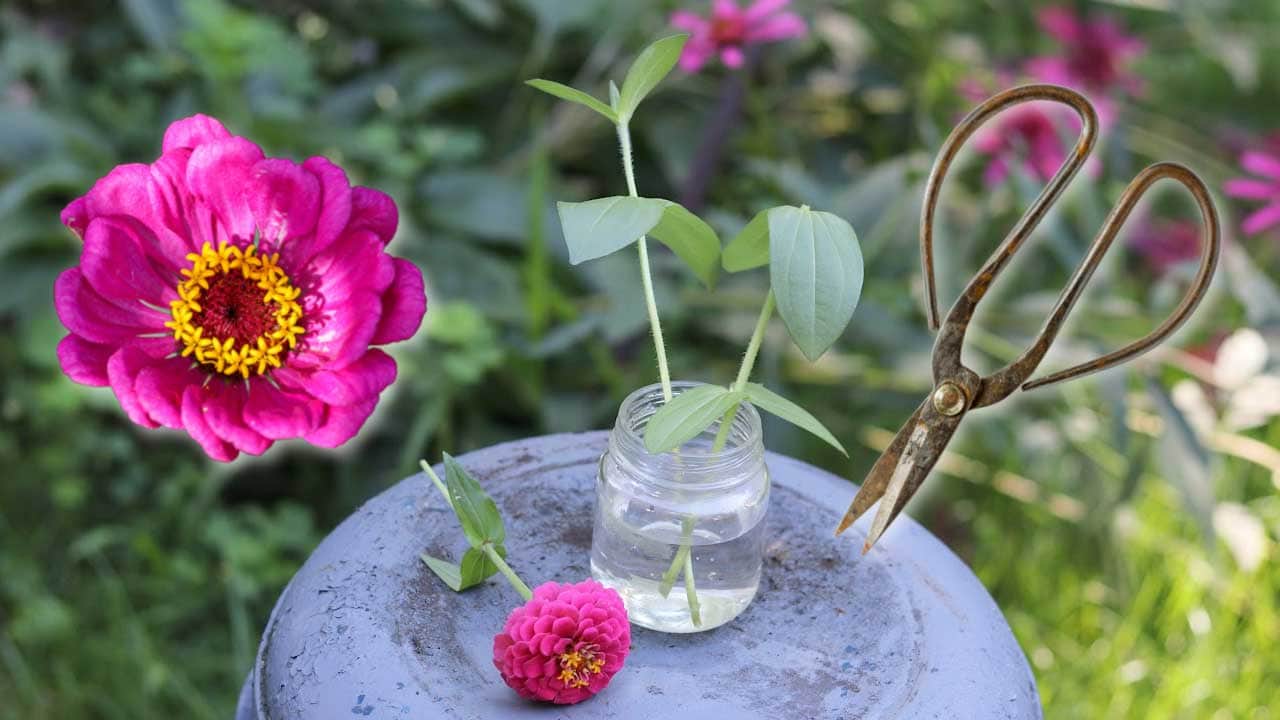
Growing zinnias from stem cuttings is an easy method of propagation to obtain new plants. Cuttings can be rooted in water and are ready for planting in just a few weeks.
Also see 7 Tips for Growing Zinnias to learn about optimal growing conditions, picking, deadheading, and saving seeds.
Propagate with zinnia cuttings
Zinnias are sun-loving annuals that are loved by many gardeners because they produce gorgeous flowers with a long flowering cycle, grow more when picked, and root easily from cuttings.
You can grow zinnias from seeds or start new plants from stem cuttings by following these steps.
content
What is stem cutting?
Before propagating zinnia cuttings, it’s important to understand what cuttings are so you know exactly where on the plant the roots will grow.
A cutting is a piece of stem that has been specially selected to root and grow into a new plant. When we propagate this way, we are simply taking an existing part of the plant (the “clone”) and growing it separately, so it is “vegetative” rather than “sexual” reproduction. No flowering or pollination required.
In zinnias, the plant has more than one stem. When the plant is young, you may notice that the stems are slightly hairy. That’s normal.
You’ll also notice that the leaves that grow opposite each other are “sessile,” meaning they’re attached directly to the stem without a stem or peduncle.
In zinnias, roots can also grow in this area of the stem where leaves grow.
What other flowers can you grow from cuttings?
In addition to zinnias, begonias and marigolds are also propagated using this method. It has a list of 12 flowering annuals that can be grown from cuttings.
If you have native plants, there are 20 varieties of native plants that you can grow from cuttings.
How to take zinnia cuttings
When should I consume zinnia cuttings?

This can be done at any time, but young cuttings tend to do better. And you want to give your cuttings enough time to grow, bud, and flower before the cold weather sets in.
Many gardeners take cuttings for rooting when pinching zinnias.
To take cuttings, ideally wait until the plant’s stem is at least 8 to 12 inches long and has several sets of leaves, but not yet budding or flowering.
This method is similar to that used to take coniferous cuttings from plants such as coleus, geranium (pelargonium), and viburnum.

step
Select a stem with multiple leaves.
The top of the stem is the tip. The place you will cut will be your base.
For this example, select a stem with three sets of leaves.
Cut the base of the stem from the plant, making a diagonal cut if possible, just below the bottom leaf.
Gently remove the bottom leaves by cutting or pinching them at the stem.
Place the base of the stem in warm water so that the bottom 2 inches are submerged. There should be no leaves in the water.
Store in a warm, protected place (75°F | 24°C) away from direct sunlight.
Change the water every day or two.
Roots should appear within 5-10 days.

The following image shows the roots after the cuttings were left in water for two weeks. You can see that new small leaves are also forming at the nodes. Some roots may develop further up the stem.

Plant zinnia cuttings
Rooted cuttings can be planted into potting mix in a container or directly into the ground if the soil is suitable.
The top of the roots should be about 0.5 inch (just over 1 cm) below the soil surface.
Zinnias are fussy about change, especially sudden exposure to strong sunlight, so I prefer to transplant them into containers in the spring so that they can be gradually transitioned to a new location, similar to “hardening off” seedlings.
planting in the ground
Plant rooted cuttings directly in a sunny location with fertile soil. Full sun means the site receives a total of at least 6 hours of direct sunlight each day. It doesn’t have to be 6 hours straight. Here’s more information on how to assess solar conditions in your garden.
If the sun is strong, consider using shade cloth or other means to block out the heat and light and make it easier to adjust to new conditions.
Water the roots to keep them from drying out.
plant in container
As mentioned above, cuttings can also be grown continuously in containers or later transplanted into the ground.
Zinnias can be picky about change, so keep repotting to a minimum if possible.
Can zinnias be grown indoors?
Zinnias are not very suitable for growing indoors. While they may thrive in a sunny window during the summer, most gardeners say they’d rather grow them outdoors because they’re much better off.
However, you can also produce short-lived flowers indoors.
This cutting (below) was cut from a zinnia stem that had just begun to sprout. I placed the cutting in water on a sunny windowsill, and two weeks later this little flower bloomed. It is about 1/3 the size of the outdoor flowers of the same plant.
It would be very cute to display many jars containing these small flowers on a windowsill.

resource
Once you try it, rooting your zinnias and growing lots of new plants in your garden will become your daily routine.
Once blooming, remember to mark the best flowers with a ribbon and leave them to save the seeds. We will show you how to harvest zinnia seeds.
~Melissa Empress of Dirt ♛
ebook

Kitchen Breeding Handbook
7 fruits and vegetables that can be regrown as houseplants
Written by Melissa J. Will
Learn how to use leftover seeds, seeds, and roots to grow houseplants like avocados, oranges, lemons, ginger, and more.
PayPal, credit card, Apple Pay
This eBook is a digital file (in PDF format) that is saved on your device. It’s not a physical product.
About this ebook |Visit the ebook shop