What is the secret to the public health community’s victories when past attempts to regulate the food industry failed?
There are three broad approaches to mediating the ruin of risky choices. This means informing people (e.g., labeling them), engaging people (e.g., offering financial incentives), or intervening directly to reduce the harm of an activity. Which do you think would have prevented more car fatalities: requiring driver education, labeling cars for crash hazards, or simply removing the human element entirely by ensuring airbags are installed? See here and in my video “How We Won the Fight to Ban Trans Fat” at 0:52 Nutrition campaigns in public education have ranged from “sugar pack” ads on public transportation informing consumers of the amount of sugar in soft drinks to “hot dogs cause butt cancer” billboards educating people about the link between processed meats and colorectal cancer, as shown in .
But is there a way to make products nutritionally safer in the first place?
The ban on trans fats provides a useful lesson. A 1993 Harvard University Nurse Study found that high intakes of trans fats can increase the risk of heart disease by 50%. This is where the story of trans fats began in Denmark, and ended ten years later with the banning of trans fats in 2003. But it took another decade before the United States began considering a ban. All the while, trans fats are killing an estimated tens of thousands of Americans each year, resulting in years of healthy life lost to diseases like meningitis, cervical cancer, and multiple sclerosis. If so many people are suffering and dying, why did it take so long for the United States to suggest taking action?
The fight to ban trans fats in New York City can be seen as a microcosm of the national debate. There was fierce opposition from the food industry, which likened the city to a “nanny state” and complained about “government interference.” Because trans fats occur naturally in meat and dairy products, the livestock industry echoed the Shortening and Cooking Oil Institute’s argument that everything should be consumed in moderation. Critics have called these proposals “the rise of food fascism.” But it was the restaurants and food industry that limited consumer choice by broadly contaminating the food supply with these dangerous fats.
Another debate revolved around what happens next if “food fanatics” get their wish to ban added trans fats. Vested corporate interests tend to rally around this kind of “slippery slope” argument to distract from the very real fact that people are dying. I mean, what if the government tried to force us to eat broccoli? This was actually addressed in the Supreme Court case over Obamacare. Chief Justice John Roberts suggested that Congress might start “mandating everyone to buy their vegetables,” something Justice Ruth Bader Ginsburg called “the broccoli scare.” Technically, Congress could force Americans to eat more plant-based foods, Justice Ginsburg wrote, but it still “cannot offer a ‘hypothetical and unrealistic possibility’ of a vegetarian nation as a credible reason.” As one legal scholar has said, “Judges and lawyers live on a slippery slope of analogy. They should not slide down it to the bottom.”
New York City has finally won the battle against trans fats and maintained its position as a public health leader. For example, New York state banned lead paint 18 years before federal action was taken, even though there had been clear evidence of lead paint’s harm for decades. Researchers compared stroke and heart attack rates before and after implementing trans fat bans in various New York counties and estimated that they succeeded in reducing cardiovascular mortality rates by about 5%. This became the model for a nationwide ban years later. How has the public health community been able to emerge victorious when attempts to regulate the food industry have failed in the past?If you had asked me about the possibility of a national trans fat ban, I would have said, “possibly fat.”
As a leading Danish cardiologist put it, in Denmark, “Instead of warning consumers about trans fat and telling them what it is, we (Danes) simply removed it.” But we’re Americans! “In North America, we say: ‘It’s okay to put poison in food if you label it properly.’ The argument is that if people knew the risks, they should be able to eat whatever they wanted. But that assumes all the facts are given, and given the food industry’s “model of systemic fraud,” as one health ethics professor puts it, that’s not necessarily the case. Given the penchant for predatory deception and manipulation, government intervention was considered necessary, but how could it be passed?
First, there was a duty to display. Manufacturers had to add trans fat content to their products’ nutritional labels. This was ostensibly to influence consumers, but it may have had a much bigger impact on producers. Now that the truth has to be revealed, companies are scrambling to reformulate their products to gain a competitive edge with “zero trans fat.”
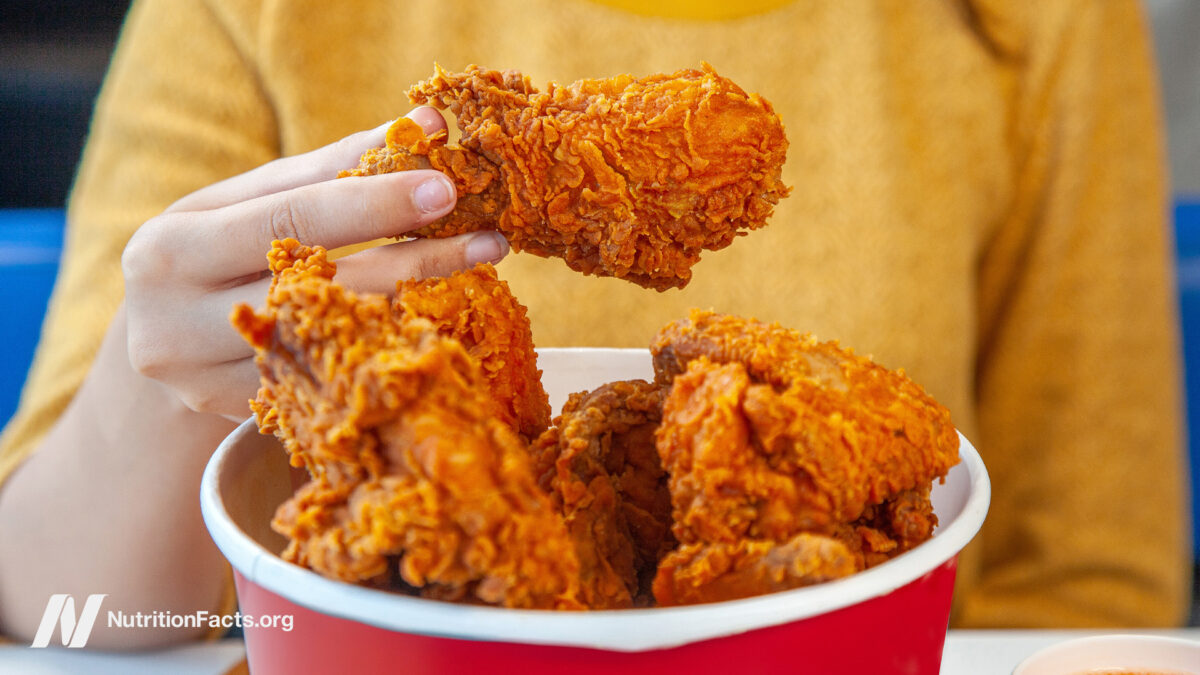
Within a few years of mandatory disclosure, more than 5,000 products were introduced that advertised low or no trans fat on their labels. Kentucky Fried Chicken was sued for having the highest levels of trans fat, leading to an ad campaign in which a mother tells a father in front of his child that KFC has zero grams of trans fat, and the father exclaims, “Yes, baby! Oooh!!” Then he starts eating buckets of fried chicken. That was the secret to passing prohibition. At a time when major players in the food industry were already reformulating their products and bragging about it, and when there wasn’t as much money at stake, there was insufficient political will to block the ban, and additional trans fats were taken out of the competition.
doctor’s note
It is important to note that the trans fat ban did not affect trans fats found in meat and dairy products. See Trans fats, but not animal fats, in processed foods.
In case you missed it, the video “Do Healthy Fast Food Options Lead to Healthy Choices?” discussed how listing calories on menus doesn’t actually prevent people from choosing healthier options.
Stay tuned for our ultra-processed junk food test.