short answer
Monk fruit and erythritol are not actually competitors and work differently. Monk fruit is a fruit extract that is very sweet without being bulky. Erythritol is a sugar alcohol that adds bulk and sugar-like texture, but is only mildly sweet. That’s exactly why many sweeteners combine the two. The real question is not which one is better, but whether you want a blend or pure monk fruit alone.
If you’ve ever purchased a natural sweetener, you’ve almost certainly seen monk fruit and erythritol go against each other. It’s a slightly misleading combination. Once you understand what each one actually does, you’ll understand why they work together more often than separately, and you’ll know which option is right for your kitchen.
What is monk fruit?
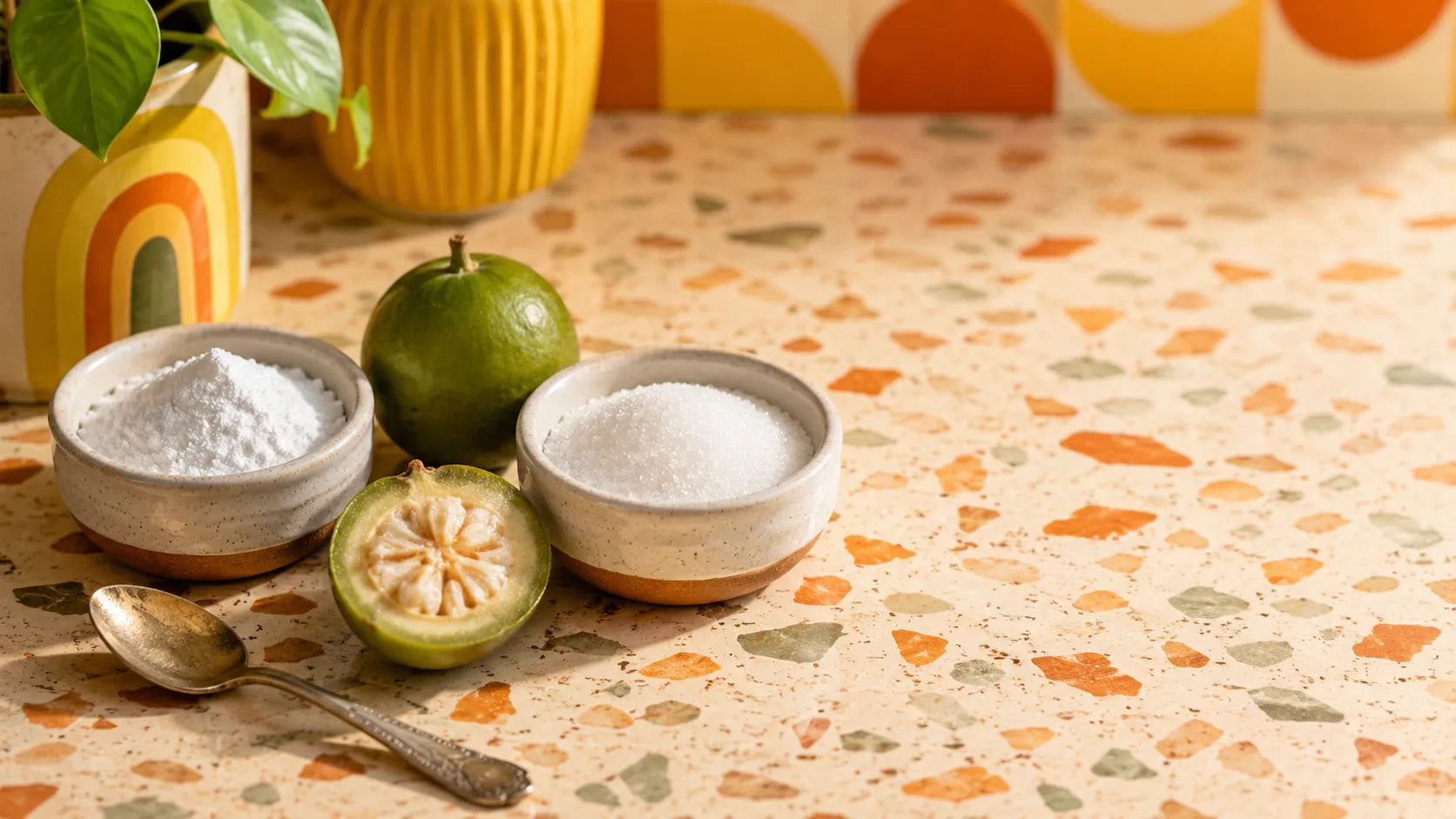
Monk fruit (Luo Hanguo) is a small green melon from southern China. Because its sweet taste comes from natural compounds called mogrosides rather than sugar, current evidence shows that it does not have a significant effect on blood sugar levels. In its pure form, it is extremely sweet, said to be 150 to 250 times sweeter than table sugar, and has essentially no calories. The problem is that it doesn’t have any bulk, so it’s difficult to measure and bake on its own.
What is erythritol?
Erythritol is a sugar alcohol that occurs naturally in some fruits and is commercially produced by fermentation. It is about 70% sweeter than sugar and has a glycemic index of almost zero, but most of it is absorbed without being metabolized and excreted unchanged, so it has virtually no usable calories. Importantly, it closely resembles sugar in appearance and size, and has a volume and texture that monk fruit lacks.
Key Idea: Monk fruit provides sweetness and erythritol provides richness. The blend acts like real sugar because each covers the weaknesses of the other.
Comparison of monk fruit and erythritol
Aconite Erythritol Type Fruit-based sweetener Sugar alcohol (polyol) Sweetness vs. sugar Much sweeter (stronger) ~70% as sweet Bulk/texture None Sugar-like bulk Calories Zero to very low Virtually zero Glycemic index ~0 ~0 Aftertaste Clean (can be bitter if poor quality) Mild cooling Best role Sweetness Ease of measurement and texture
Why are these often combined?
This is where the “vs” framing is lacking. Most products labeled simply as “monk fruit sweetener” are actually mostly erythritol with a small amount of monk fruit added. It’s not a trick, it’s a good formulation. Pure monk fruit is too concentrated to accurately spoon into tea, while pure erythritol isn’t sweet enough and can taste a bit cool on its own. When you combine these, you get a sweetener that tastes like sugar, in similar amounts, and avoids the effects on blood sugar levels.
This is the idea behind our monk fruit decoction and erythritol sweetener. Erythritol gives it a granular, sugar-like body, so it is swapped 1:1 in recipes, and the monk fruit decoction rounds out the flavor and counteracts the cooling sensation of erythritol. When used together, the two truly complement each other.
taste and digestion
To taste, monk fruit has a cleaner, more neutral flavor, while erythritol provides a mild cooling sensation, a bit like mint without the sugar. When blended, monk fruit provides a soothing cooling sensation, but when mixed into a hot drink or baked into something, most people don’t notice the cooling effect.
Erythritol is one of the sugar alcohols that is better tolerated during digestion because it is mostly absorbed in the small intestine, rather than being further fermented in the intestines like maltitol and sorbitol. Normal amounts are fine for most people. A small amount of pure monk fruit will make it even more gentle. If you know sugar alcohols aren’t for you, that’s the main reason to choose monk fruit on its own.
Which one should you choose?
One is not “better” than the other, it depends on the job.
Choose a monk fruit and erythritol blend if:
Suppose you want to exchange sugar for sugar directly 1:1 without doing any calculations. I bake bread regularly for a sugar-like texture. I love the familiar look and feel of granulated sugar in a bowl.
Our Monk Fruit Decoction & Erythritol Sweetener (500g, £9.99) is made for exactly this, with zero net carbs, zero calories and easy baking.
Choose pure monk fruit if:
It is best to avoid sugar alcohols completely. I don’t like the refreshing aftertaste. Primarily for drinks, you want as short an ingredient list as possible.
Our Monk Fruit Decoction Powder (Erythritol Free) (100g, £11.99) is monk fruit decoction powder with a little bit of soluble tapioca fibre. No erythritol and no cooling sensation. It is about three times sweeter than sugar, so the amount used is about one third.
Many people keep both pure powders for coffee and tea and blends for baking. You can compare them in our monk fruit sweetener collection.
FAQ
Is monk fruit better than erythritol?
It’s not that one is simply better than the other; their roles are different. Monk fruit provides intense sweetness. Erythritol imparts bulk and a sugary texture. Most sweeteners combine these because they work best when used together.
Why is erythritol added to Luo Han Guo sweetener?
Pure monk fruit is too sweet to measure easily. Erythritol adds a bulk, grainy texture that allows the blend to be replaced 1:1 with sugar in recipes.
Do monk fruit and erythritol raise blood sugar levels?
Current evidence shows that both significantly increase blood sugar levels. Both have near-zero glycemic indexes, making the blend popular for keto and low-carb diets.
Which one has less aftertaste?
Monk fruit is cleaner and more neutral. Erythritol has a mild cooling sensation, softened when blended with monk fruit.
Can I use monk fruit without erythritol?
yes. Pure monk fruit powder is completely free of sugar alcohols. It’s perfect if sugar alcohol doesn’t suit you or if you don’t like the cooling sensation. Note that it is much more concentrated, so you will use much less.