2026/01/20
MT:
Welcome, I’m Nate Green from the Waking Up app. I am very excited to be able to meet you in person for the first time. We only spoke briefly on the phone and did business through email, but I was really happy to see their smiling faces. Now you have a new home. I have a new house.
NG:
thank you. Yeah. My wife and I spent the holidays laying floors and hauling everything in rather than spending the holidays with family and friends. So I’m glad to finally be able to settle down.
MT:
sweet. And do you think this is a new video setting?
NG:
Yes, everything is new. I feel so fresh right now and it’s so good.
MT:
That’s great. Well, congratulations on your new home. That’s amazing.
NG:
thank you. And thank you. Please continue to express your gratitude. Thank you for your recent contributions to the app. I know that’s the main reason we’re here. I just want to say, I’ve been a fan of yours for many years. I’ve listened to at least a dozen conversations on your podcast. I think you are doing a great job. I’m really happy to finally be able to do an hour of meditation with this app. This is what breaks the app. This is the longest meditation we currently do.
MT:
Well, I like long meditations, so I’m honored to be able to break the app like that. Now let’s talk about the app. This is Sam Harris’ Waking Up app. You are the production manager there. It may not be well known, so please tell us a little about the app and the series.
NG:
Yes, that’s great. I’ve been here for five years, but I think this app is seven years old. It was created by Sam Harris, a neuroscientist, author, philosopher, and many other things you can add to the front of your name. Although he probably wouldn’t call himself a meditation teacher, he certainly introduced many people to meditation.
He wrote Waking Up in 2014 and this app is based on insights from that book. What’s interesting about Sam is that people mostly knew him as one of the Four Horsemen of New Atheism, but what they didn’t know was that he spent most of his 20s traveling back and forth between Nepal and India, primarily as a teacher of Tibetan Buddhism and a student of the Advaita tradition.
When he created this app, he wanted to present the teachings of many traditions in a secular way so that modern people can connect with these deep wisdom teachings. My role is to help manage the content for the app. I myself am deeply involved in the practice of meditation and was a user of the app before joining the team. Great job.
MT:
You’re doing a great job. I think this is the best app in the field of meditation. Virtually everyone I work with uses it at some point. I was very happy to be invited to do a series on the app. I interviewed him a while back, and now he has asked me to do this 10-part series.
NG:
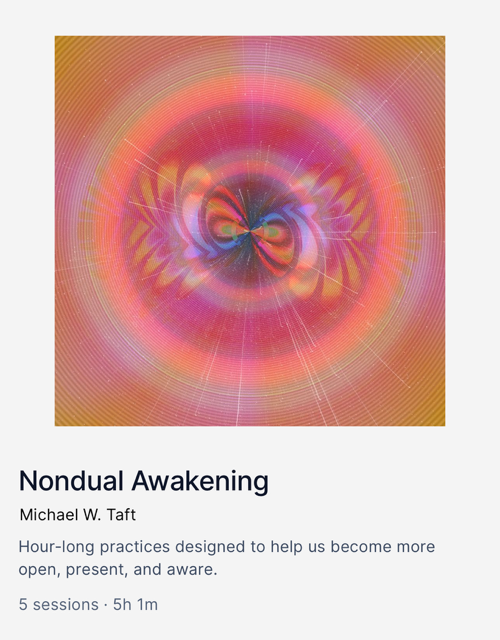
Yes, non-dual awakening.
MT:
right. The title says it all. When will this be published? How can people check it out?
NG:
The best way is to go to wakingup.com/michaeltaft. Anyone who goes there can get a 30-day free trial. No credit card required. They can listen to your series and everything else on the app. We have the entire Alan Watts collection as well as many of your colleagues and contemporaries.
The series will be released on January 20th. Part 1 will then go live. Half of the sessions are available now, and the rest will be published within the next month or two.
MT:
Just to clarify, I receive no affiliate fees for this. This is just a gift from Waking Up to help people explore the app.
NG:
And let me add a few words on that point. We are the most expensive meditation app and at the same time completely free for those who don’t have money. Over 100,000 people are using this app completely free of charge. Those who pay are essentially giving subsidies to those who cannot pay. We grant 100% of scholarship requests. We don’t want money to be a barrier.
MT:
This scholarship model is one of the main reasons I think this app is great. It’s rare and really cool. I am truly honored to be included among the teachers there.
I will briefly explain the Non-Dual Awakening series. I wanted to cover the full range of what I teach, including things you don’t often see on the app. We begin with rest, space, stillness, and silence. Vipasyana then practices seeing the emptiness of various aspects of experience, tonglen, and practices of love and kindness.
But then I went in a direction that you don’t often hear about in apps, which is to work with energy in a non-dual way. Three or four of the 10 meditations were very energy-focused.
NG:
Yes, that’s right. We don’t have much of that. One of the criticisms we hear from people “in the know” is that Waking Up is very mindless, very consciousness-focused, and lacks energetics. I think that’s a fair criticism in a sense. I’m really grateful to you for moving that dimension forward.
In my own practice, I have found it very helpful to work with energy patterns and observe their emptiness. I found the spots that needed to be filled in and finished them off beautifully.
MT:
If you look at Mahamudra, Dzogchen, Vajrayana Tantra, they are very energy-based. There is such a practice. There are ways to talk about energy in a secular way. I gave it my best shot.
NG:
I think it was successful. You used the term “central channel” and we kept it that way. These experiences are here to be experienced, so we might as well talk about them.
MT:
that’s right. And one of the first meditations that I heard from you that I thought was great was dropping the ball. It’s here. I was listening to Energy Turns to Space before this call and your point is incredibly accurate. The way you talk about not just the energy in the body, but the energy behind the breath, breaks down a lot of things beautifully.
NG:
thank you. That means a lot.
MT:
Well, let’s finish. How do people sign up?
NG:
Visit wakeup.com/michaeltaft. Free for 30 days, no credit card required. Please be there if you can.
MT:
wonderful. Thank you so much, Nate. I hope to talk to you again soon.
NG:
Thank you, Michael.