June 23, 2026
The final garden on our Pueblo Open Day tour two weeks ago was the Midway Xeric Garden. As soon as I drove into historic Pueblo’s “The Blocks” neighborhood, I knew this was going to be my favorite garden – the Artist’s Garden.

The old brick houses on the street had colorful murals painted on them, and the small neighborhood park featured recycled art sculptures. There is a lot of creativity and unconventional design on display.

The agave was blooming in the street garden, its Dr. Seussian flower spikes burning on the sidewalk in the midday light.

Agave flowers open

Another agave had already finished its flowering cycle and was dying like them. It was left as a natural sculpture.

Colorful horned poppies were blooming in the crevices of the rocks, braving the midday heat.

The potted Kanagaru cactus was also bathed in sunlight.

The owner is clearly a cactus enthusiast.

Who else was sunbathing? This striped lizard. My daughter let me pose for a photo. We saw many lizards in this rocky garden.

Sorry for the harsh light. Visiting the gardens at noon in the Colorado sun is a challenge for photography. But you’ll appreciate the delightful eclecticism of this garden perched atop a rocky cliff. Distant views are framed by swinging arbor and concrete portals. Peek over the edge of the cliff and see the treetops and commercial district below.

The first thing that caught my eye was the portal. Concrete pillars support rows of numbers 4.66920160910 covered in colorful tiles. I asked the owner, Bobby, what that meant. “Google it,” he said with a smile. A quick Google search turns up some math-y jokes about Feigenbaum’s constant. Oh, was this a pop quiz I didn’t study for?

Bobby, who studied physics, explains that it has to do with chaos theory, which has always fascinated him. If I remember correctly, this number is a universal mathematical constant that measures how quickly a system moves from order to chaos.

gas accepts everything

got it. It makes sense to recognize the confusion and call it out. After all, gardeners experience chaos on a daily basis, right? We are always trying to create a sense of order while nature continues to work to make everything wild again.
I continued my exploration, enjoying a pot balanced on a pillar, with images of Jurassic Park’s Jeff Goldblum explaining chaos theory in my mind (a chaotic moment one step away from destruction)…

…Plants appearing along the layered concrete wall…

…This gorgeous agave and its shadow…

…and potted cacti everywhere.

Bobby builds the hardscape himself, including concrete walls, sheds, gates, and colored patio pavers. In fact, a concrete mixer was also available. But he told me that this blue patio with numbers painted on it was upcycled concrete from the pool. Isn’t it so much fun?

A sky-blue pot containing a cactus perches on a delicate pillar at one end.

flowering cactus

Melting totem pole cactus

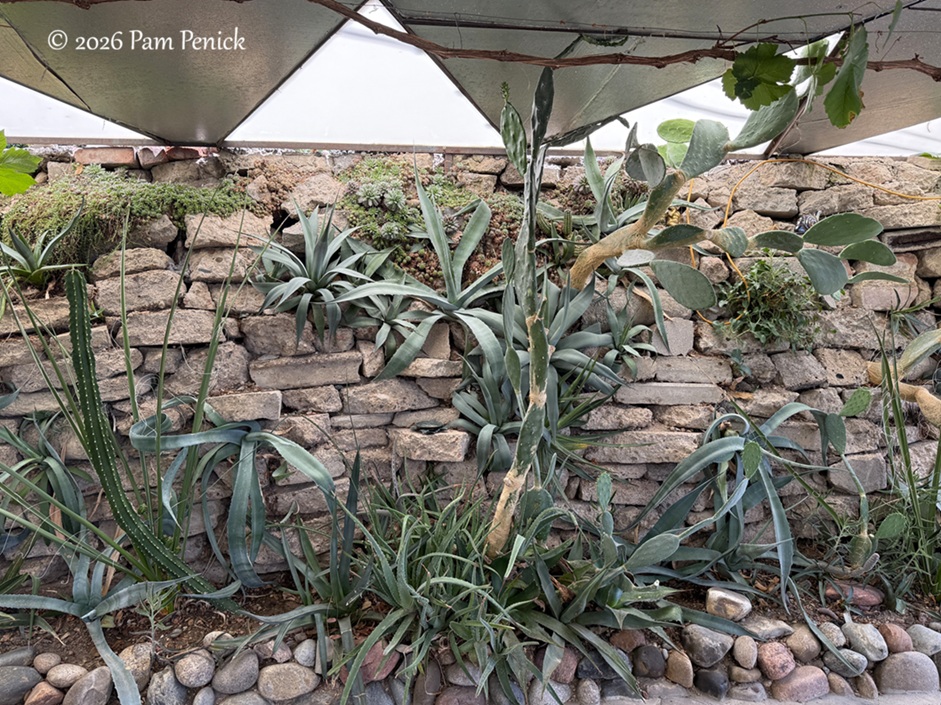
Then I found Bobby’s Greenhouse—wow! A prickly pear cactus the size of a baby giraffe was pressed against the window as if looking for an escape hatch.

Inside, the broken concrete rubble walls are home to crevice-loving plants such as agave, cacti, and other succulents. A triangular metal roof provides shade. Bobby said the structure can be fully winterized to keep tender plants healthy during the colder months.

Plants basking in the sun like cats

There are grapes hanging on the doorstep.

Outside, another agave was blooming.

Stairs along one side of the garden lead to the street below. Bobby built walls and terraces of colored concrete and gabions to support the edge of the garden and extend it to the side of the cliff.

A dizzying view of a colored concrete path descending through a hillside garden.

pueblo brick

Bobby upcycled broken concrete slabs to create a “stone” wall studded with succulents – an Anthropocene hanging garden. Artistic gardeners are skilled at turning found objects, such as concrete scraps, into something new and interesting. They just see things differently.

Visiting gardens like this gives us all permission to recycle and reuse. And to allow the plants to find their way, even if it’s a bit confusing.
This concludes our coverage of the Pueblo Open Day Tour. Click here for a look back at the pollinator-friendly Sage Queen Garden.
We look forward to your comments. If you want to keep one, scroll to the end of this post. If you’re reading by email, click here to go to Digging and find the comment box at the end of each post. By the way, someone forwarded this email to you and would you like to subscribe? Click here to get Digging delivered straight to your inbox.
__________________________

dig deeper
“‘Gardens of Texas’ is not your typical doorstop-cum-coffee-table book full of beautiful images of beautiful gardens you could never hope to realize. The photographs are definitely inspiring, but Pam’s thoughtful and detailed storytelling and the ‘Try This At Home’s features make me feel empowered to create similar garden magic…on a late August afternoon when the mercury soars in Austin and we’re stuck indoors, this is what I curl up with. ”
–MomInAustin, Amazon Reviewer
Gardens of Texas: A vision of resilience from the Lone Star State is here! Enjoyed by anyone who loves gardens and the natural beauty of Texas. Available at Amazon, other online book retailers, and stores nationwide. Click here for more information.
All materials © 2026 by Pam Penick for Digging. All rights reserved.