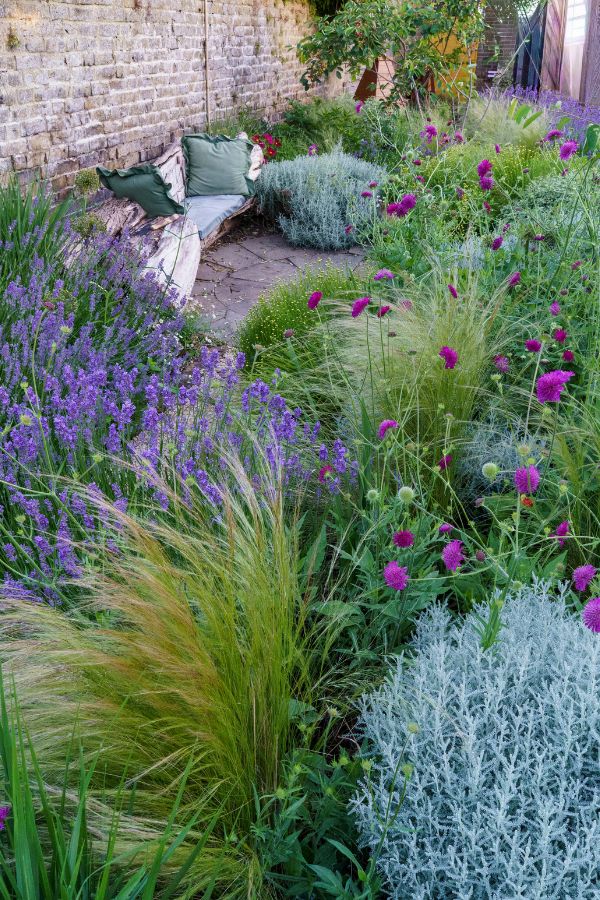
Garden designer Edmund Jackson transformed his small garden from an overgrown mess into a space featured on BBC Gardeners World.
The property had been vacant for two years and was overgrown with 8-foot-tall bindweed. A huge tree, 25 meters high, occupied the site.
However, the main challenge was the shape. It was 30 meters long and only 5 meters wide (about 100 feet by 16 feet), giving it the appearance of a narrow hallway. Now it’s alive with color, texture, and year-round interest.
Before and after photos of Edmund Jackson’s long narrow garden. As you travel, a garden “later” catches your eye, but you don’t actually know what size or shape it is. Even the hut in the same location as the previous hut seems far away.
Edmund Jackson’s garden is one of 25 gardens that will be open at Faversham Open Gardens & Garden Market Day on Sunday 28th June from 10am to 5pm. For more information, see the National Garden Plan.
See the garden in the video here.
Why small gardens fail (and how to fix it)
A 30m x 5m plot presents a very specific visual problem. The line of sight extends straight to the edge, making the garden feel like a corridor.
Traditionally, gardeners placed beds on either side of a central path. However, this approach does the opposite of what is needed. The hallway-like length is emphasized rather than disguised.
And since the eye immediately goes to the back of the garden, the space feels smaller.

You can quickly see the entire space and see exactly how long or narrow it is.
So Edmund’s first rule was to block his line of sight.
He accomplished this by creating three wide flower beds in his garden, each planted with multi-stemmed amerantia.
“When you walk into the garden, you can’t really see the end of it,” he says. “You want to take that step and explore the rest of the garden: what’s beyond that tree, what’s beyond that corner.”

Each border has multiple-stemmed amelanchiae to add height and break up the line of sight. It never grows into a large tree and gives dappled light, making it suitable for small gardens.
Winding roads: simple tools that have a big impact
Rather than a straight central path, Edmund decided on what he called a “winding path.”
Some people think that a winding road is a crooked road, and this can still work. However, the curves create pinch points, making them difficult to plant in narrow gardens or small spaces.
So Edmund has a doglegged path at right angles, dividing the garden into a series of wide borders with a path on one side.
Splitting a path line does several things at once.
Divide your garden into clear zones without the need for hard dividing structures that suggest there’s more left to be discovered by creating corners and bends that slow the line of sight so it doesn’t reach the boundary directly

Edmund Jackson’s Narrow Garden Plans. You can see that the path starts on the left, goes straight up, turns at a right angle, and continues on the right to the dining terrace. From there, it turns again and continues to the back of the garden and to the shed.
Edmund also used different materials for different sections of the path, repeating patterns of gravel, stone, wood, bark chips, and brick in different combinations.
Putting an extra-large bed in a small garden: Counterintuitive, but it works.
Having a path on one side or the other (but not on both sides) means that you can plant a large enough bed.
If you have a path in the middle of a small space, the borders on both sides will also be smaller, making it harder to plant.
And a large border is not only easier to plant, but also has more impact. One of the most striking design choices here is the scale of the planting bed.

This log bench was made by reusing a huge tree that had to be removed due to disease. It is surrounded by lush plantings with a 3m x 3m border.
Three main beds separate the garden, each approximately 3 meters wide in a garden that is only 5 meters wide. This means that the bed will occupy more than half the width of the site.
This may make your garden feel crowded. In fact, the opposite is true.
Spacious flower beds filled with a rich variety of plants draw the eye to the borders rather than the length of the garden. They create fencing, dividing zones and giving each section of the garden its own character.
The important thing is not to be timid. Narrow beds along the border will make your garden feel cramped. Large, bold borders create a generous impression.
Making a small space bigger is one of the best garden design tips. To learn more about our extensive range of plantings, check out our guide to garden design details that make your city garden feel larger.
And international garden designer Paul Bungay is a big fan of “going big.” Paul Bangay – See garden design inspiration.
Destination: Attracting people through space
Edmund began designing his garden by making a list of things he and his family wanted to do in their garden.
A long, narrow garden requires multiple locations.
“Suppose you put a dining table against the back wall of your house,” says Edmund. “Then there would be no reason for them to move further into the garden.”
Here, seating areas are arranged at multiple points along the route. The main dining table is positioned in the afternoon and evening sun and was intentionally chosen for entertaining.
You can do that with many features in your garden: sculptures, specimen trees, seating corners, anything that gives someone a reason to ask, “What’s out there?” And then we will take another step.

The seating area (upper part) is located halfway up the garden, in the sunniest part of the evening. If you place your dining area right outside your home, you often don’t have to go deep into your garden. The play area, which can be seen through the Ameranthi trees, is located near the kitchen door, so you can keep an eye on the children.
Planting for structure, repetition, and year-round interest
Edmund selected a limited palette of plants and repeated them across different borders, albeit with some differences. In small or narrow gardens, repeating the same plants creates cohesion without monotony. He selected important structural plants that will remain in shape until winter.
The main plants used throughout include:
Lavender (including the mountain-forming cultivar Hidcote) – Hakonechloa macra (Japanese forest grass) repeated throughout for structure and aroma; a mountain-forming ornamental grass Pitsporum ‘Silver Ball’ with a soft, flowing texture; Stipa tenuissima, a neat, rounded shrub that mirrors the hill-like shape of the lavender; – a narrow-leaved grass with a delicate, flowing habit; Santorina (3 varieties) – silver-leafed, long-lasting structure from autumn to winter.

The main plants in Edmund Jackson’s garden. They are repeated in different ways across borders. Most of these plants can tolerate temperatures down to -28C/-20C and can be replanted annually as annuals, making them work in a wide range of regions and climates.
He mainly chose small plants, 9 cm. Because it’s the cheapest way to plant a garden.
But the first year it can look gaping, so I planted annuals that went to seed, such as daisies and Cynautia macedonica.
Since then, self-seeding has filled every gap. This dense planting also helps prevent weed seeds from becoming established.
Material: The secret of a garden with an established atmosphere

Edmund found these pavers under an old shed. If you live in a city, especially one with a Victorian housing stock, you may be surprised at what’s buried just a few feet below the soil surface.
Not everyone is lucky enough to find a nice paver buried in their garden (but it’s always worth checking). However, reclaimed pavers and other materials are available from salvage yards and reclamation centers.
Using recycled materials can give your garden a sense of antiquity and character. Find a material that suits the climate of your home and neighborhood. That way the garden will feel like it belongs there and not something that was recently installed.
Even in show gardens, recycled hard landscaping materials are now used wherever possible. Check out RHS Chelsea’s recycled garden ideas.
And if you want to be the kind of person who sees the good in what seems like trash, read over 20 recycled gardening ideas that are creative, sustainable, and thrifty. Contains good advice on finding the right materials.
Edmund also bought new Cotswold gravel and reclaimed grade bark chips to mix in with the pavers and wooden ties he found.

Recycled wooden sleepers, salvaged wooden step stool “stones” and recreational grade bark chips.
Garden Path Materials: See the Good, the Bad, and the Beautiful.
Design of a narrow garden – important principles
Edmund’s advice for anyone looking to transform a small garden:
First decide how you want to use the space (eating, playing, sitting, nurturing), then plan around those uses. Block your line of sight. Use plantings, trees, or sculptures to prevent the eye from reaching far-flung borders all at once. Don’t automatically think of the path through the middle. Run one side or add a turn. Be careful when choosing paths with curves, as it can be difficult to plant around them. Please be generous with the size of your bed. A border that is too large will make a small garden feel larger without making it smaller. Create destination points in different parts of your garden to draw people there. These include seating, dining, or utilitarian areas. Repeat structural plants throughout the bed to create a sense of unity and flow. Choose plants of winter interest – grasses, silver-leafed shrubs, and structural forms extend the garden season well beyond summer. Link materials to the home – using reclaimed or locally sourced stone or brick will help your new work settle in faster and feel more established
What began as an impenetrable bindweed thicket is now a layered, immersive space that rewards exploration. Its designers describe the space as having the feeling of being “immersed in nature.” His young son is looking for bugs at the border. A family eats outdoors on a summer evening at a table in the last rays of the sun.
And it was the successful beginning of a new garden design career.
There are lots of real-life examples here with great tips for small and narrow gardens.
To contact Edmund, visit Edmund Jackson Garden Design.
Pin to remember small garden design tips
And please join us. Click here for a free weekly newsletter packed with gardening tips, ideas and inspiration.