Instructions
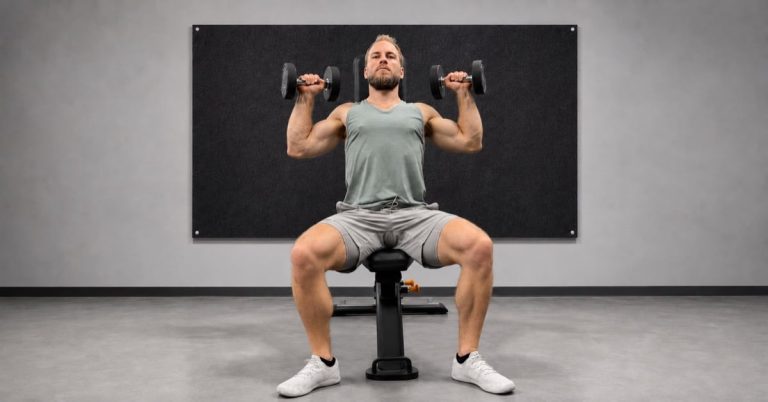
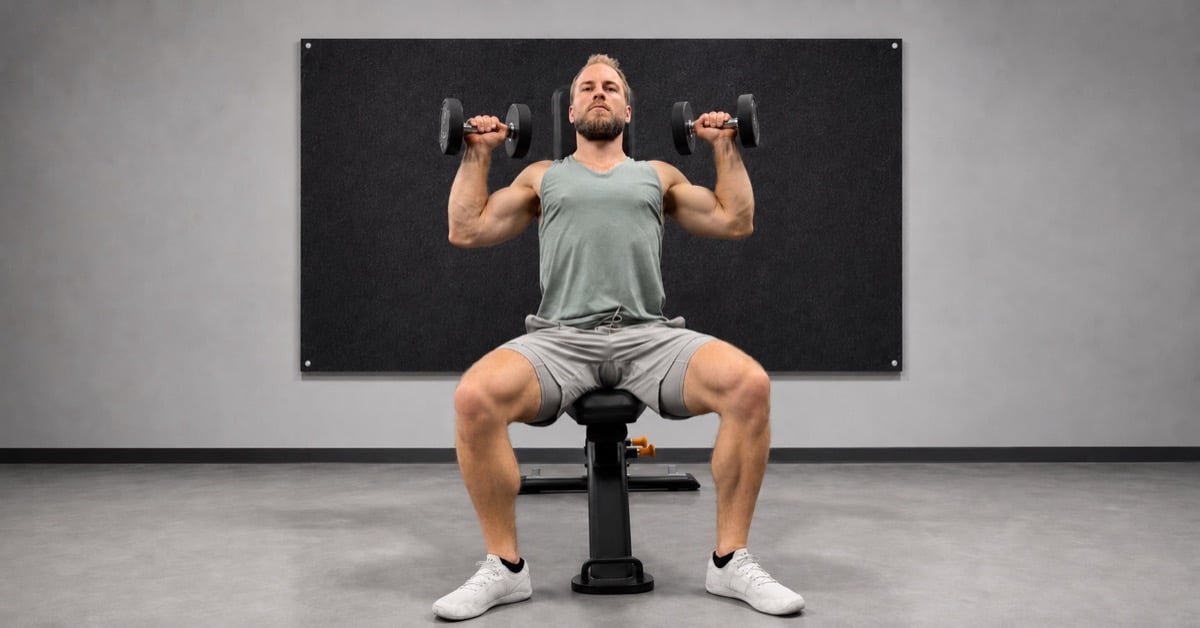
Sit on an upright bench with dumbbells in each hand and place them on your thighs. Gently press the dumbbells with your thighs and lift them just above your shoulders with your palms facing away from you. Press your middle and upper back into the backrest, lift your chest, and pull your shoulder blades together and down. Push the dumbbells toward the ceiling until your elbows are almost locked, moving the dumbbells closer together as your elbows straighten. Keep your middle and upper back pressed against the backrest and avoid arching your lower back too much or moving your butt forward on the bench. Reverse the movement and return to the starting position.
expert tips
Imagine pushing a dumbbell into the ceiling. This allows you to lift more weight, focus on pushing the dumbbells straight up, and avoid them hitting each other at the top of each rep. (Note: Weightlifting cues that draw your attention to how your movements relate to your surrounding environment (in this case, the dumbbells and the ceiling) are almost always more effective than ones that focus on your own body movement and position, such as “raise your hands above your head.”) When pushing upwards in weightlifting, let your elbows drift forward slightly if that’s more comfortable. Don’t worry about keeping your upper arms fully extended to your sides throughout the entire rep. Don’t cheat by limiting your range of motion. For example, lower the dumbbells to about eye level or simply extend your arms partially above your head. This makes it easier to push heavier weights, but it also makes the exercise less effective. Before proceeding, use a weight that allows you to complete full reps. Give your body time to grow bigger and stronger, and don’t rush the process at the expense of technique. If your lower back arches too much, your body shifts on the bench, or your butt leans forward when pressing, the weights are too heavy. Lower your weight as far as you can push without squirming, then return to the starting position. Many people struggle to press dumbbells symmetrically because one side of their body is stronger than the other. Choose dumbbells that are light enough to complete full reps on your weak side. It may feel too light for your stronger side, but over time your weaker side will catch up with your stronger side and you will be able to straighten both arms equally.
mike’s opinion
The dumbbell shoulder press (also known as the dumbbell overhead press) is a great exercise for building strong, symmetrical shoulders.
That’s why it’s one of the shoulder exercises I include in both my programs for men and women: Bigger Leaner Stronger and Thinner Leaner Stronger.
It’s especially effective for training the front and lateral deltoid muscles, which have the most influence on the size and shape of your shoulders. It’s also safe, easy to learn, and requires minimal equipment.
There are two versions of the dumbbell shoulder press: seated shoulder press and standing shoulder press.
Although there is some evidence to suggest that the standing version activates slightly more shoulder muscles than the seated dumbbell press, we recommend doing the seated version because you can lift heavier weights, which may offset the benefit of higher muscle activation.
The seated shoulder press is also easy to learn, set up, and perform.
A good default is to do 3 sets of 4-6 or 6-8 repetitions with 2-3 minutes of rest in between, and repeat each set 1-2 times to avoid failure.
It’s best to program it as part of your shoulder, push, or upper body day instead of other overhead press exercises.
Alternatives to dumbbell shoulder press
If you’re having trouble with your shoulders when doing dumbbell shoulder presses, or just want to try a different method, here’s the method for you.
Arnold Press: Due to the way it rotates your wrists, it works your lateral deltoids a little more than other overhead presses and helps balance your shoulders. The downside is that the Arnold press cannot press as much weight. Machine shoulder press: The machine shoulder press isolates the shoulder muscles more effectively and makes the exercise harder to cheat, but it doesn’t train the stabilizing muscles as much as the dumbbell shoulder press. Seated Barbell Overhead Press: This is essentially the same exercise, but performed using a barbell. You can push heavier weights, but they are more cumbersome to set up. Standing Barbell Overhead Press: This requires more coordination and balance, but also allows you to press heavier weights. Barbell Push Press: This is pretty much the same as the standing barbell overhead press, except you do a little quarter squat to push the weight upwards. This allows you to use the heaviest weight, but also doesn’t isolate your shoulder muscles, triceps, and other exercises on this list. Landmine Press: Trains one side of your body at a time, helping you find and correct imbalances. The diagonal press pass is also easier on tight shoulders. It’s not my favorite variation because it’s a pain to set up and run, but it’s a viable option.
3 Dumbbell shoulder press training
Here are three sample workouts that show you how to program a dumbbell shoulder press. The same goes for shoulder-only days, push days, or even if you train at home with just dumbbells.
Shoulder training with dumbbell shoulder press
Seated Dumbbell Shoulder Press: 3 sets | 6-8 reps | 2-3 minutes rest
Dumbbell Lateral Raise: 3 sets | 8-10 reps | 2-3 minutes rest
Dumbbell rear delt fly: 3 sets | 8-10 reps | 2-3 minutes rest
Face pulls: 3 sets | 8-10 reps | 2-3 minutes rest
Presses are performed first because they are the most demanding exercise. This allows them to be at their heaviest while fresh.
Lateral raises, rear delt flies, and face pulls will develop your side and rear delts, but pressing alone will not fully develop them.
Push day training with dumbbell shoulder press
Barbell bench press: 3 sets | 4-6 reps | 2-3 minutes rest
Seated Dumbbell Shoulder Press: 3 sets | 6-8 reps | 2-3 minutes rest
Incline Dumbbell Bench Press: 3 sets | 8-10 reps | 2-3 minutes rest
Tricep pushdowns: 3 sets | 8-10 reps | 2-3 minutes rest
On push days, dumbbell shoulder presses are vertical presses inserted after the heaviest horizontal presses while the shoulders are still relatively fresh.
Upper body training with dumbbells only
Dumbbell bench press: 3 sets | 6-8 reps | 2-3 minutes rest
Seated Dumbbell Shoulder Press: 3 sets | 6-8 reps | 2-3 minutes rest
One-arm dumbbell row: 3 sets | 6-8 reps | 2-3 minutes rest
Dumbbell Lateral Raise: 3 sets | 8-10 reps | 2-3 minutes rest
When you train at home using only dumbbells, the entire upper body is loaded, and the key to this is the shoulder press. No upright bench? Do the standing version instead.
Dumbbell-only training is effective up to a point, but most dumbbell sets increase in 5-pound increments and top out at about 100 pounds, so the problem is progression. It’s fine for getting started and achieving moderate strength and muscularity, but it’s not great for continuing to make long-term progress.
Use double progressions to progress through these workouts. Work within the specified rep range and add weight once you reach the top of the range on the first set.
Dumbbell vs. Barbell Shoulder Press
Similar to the overhead press or military press, the dumbbell shoulder press involves pushing the weight overhead from shoulder height, then lowering it back down to shoulder height. The difference is that the shoulder press is performed with dumbbells instead of a barbell.
Using a barbell instead of dumbbells for seated shoulder presses allows most people to press about 10-20% more weight and allows you to transition to heavier weights faster, making it ideal for building muscle and strength.
The disadvantage is that it is difficult to set up.
The standing barbell version of the overhead press is also great. In addition to improving upper body strength and size in your shoulders, traps, triceps, and upper chest, you’ll also develop total body balance and coordination.
There’s no reason to choose just one. A simple approach that works: Every week, press with a barbell on one upper body day or push day, and use dumbbells on another day. Or rotate the two exercises every few months.
Muscles trained with dumbbell shoulder press
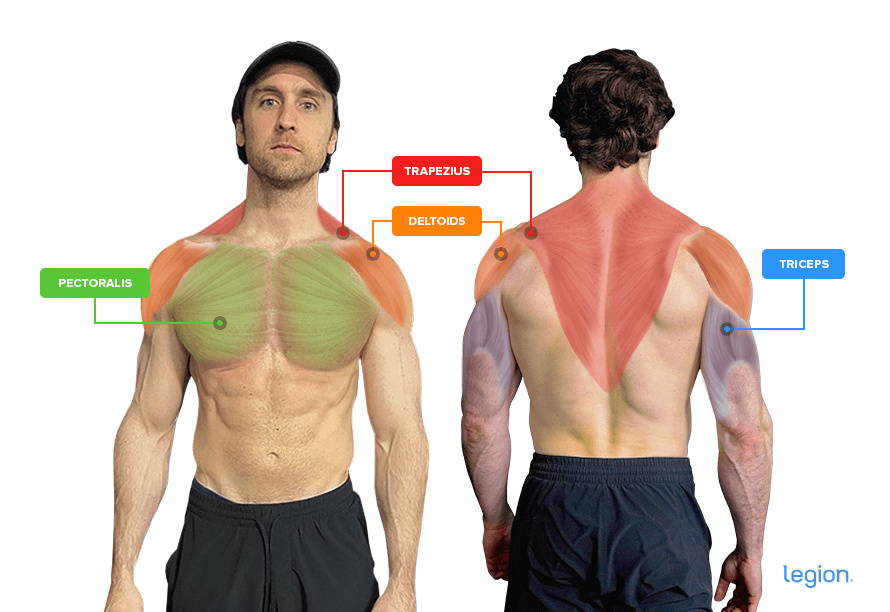
The main muscles trained with the dumbbell shoulder press are. . .
To a lesser extent, it also works your abdominals, biceps, forearms, traps, serratus anterior, and rotator cuff muscles.
There’s one thing you should know. Like other overhead presses, the dumbbell shoulder press primarily works the front and lateral (side) deltoid muscles, but rarely the rear deltoid muscles.
That’s why the shoulder workout above combines lateral delt exercises such as lateral raises and rear delt exercises such as rear delt flies. This combination trains all three parts of the shoulder, creating a truly rounded and proportionate “3D” shoulder.