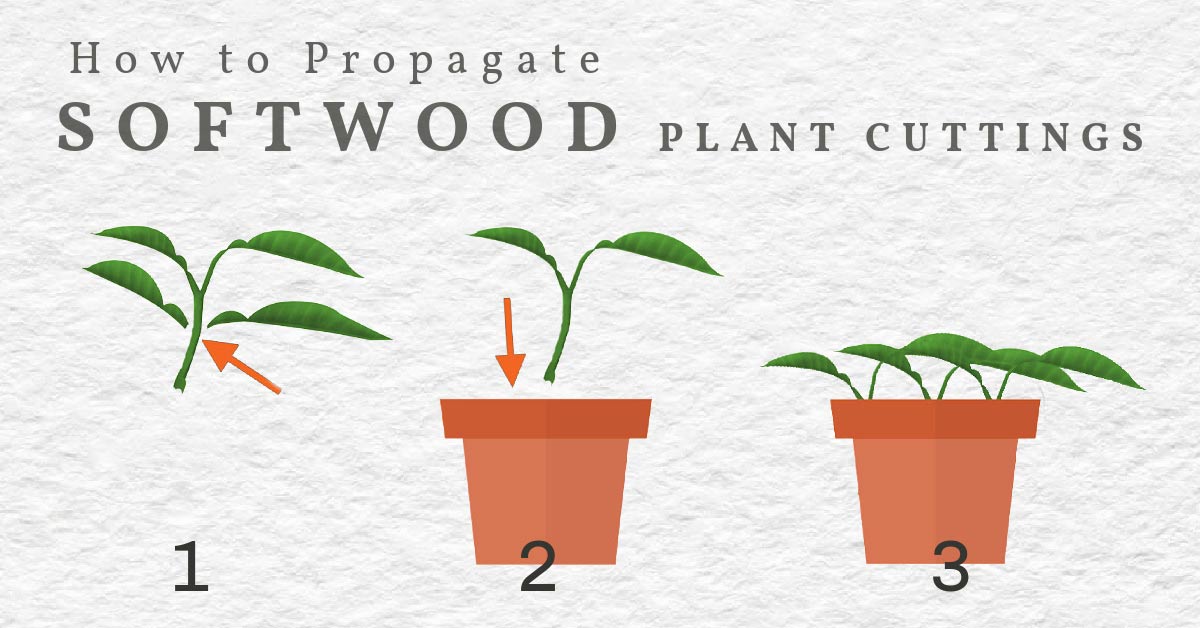
Propagate new plants from your favorite annuals and perennials using conifer cuttings. Includes recommended plants and detailed step-by-step instructions.
In late autumn and winter, old growth can be rooted: How to grow plants from hardwood cuttings.
Propagation of felling of coniferous trees

Here’s everything you need to know to start growing conifer cuttings.
We’ll tell you what they are, when to take them, list examples of plants you can try this with, and provide step-by-step instructions.
Once you know how, you can use the same skills to propagate countless other plants.
content
Start
What is coniferous felling?
Coniferous cuttings are parts of plant stems taken from woody plants while they are still green and the bark has not formed, usually in early or midsummer.
Many woody plants go through the following growth stages.
Herbaceous (grows young and green in spring)
Thin, flexible shoots bend rather than break. Conifer (starting to harden)
It may break if bent. Semi-mature or semi-hardwood (woody bark is beginning to form) Hardwood (late summer and fall)
Because of the strong protective coating, a healthy woody trunk is less likely to break when bent.
Once mature, the woody or broad-leaved stem remains in place for life, but new green shoots may develop from that same stem.
There are pros and cons to propagating cuttings at each of these stages.
At the coniferous stage, young stems are less sensitive to drought than herbaceous cuttings and grow faster than semi-woody or hardwood cuttings.
Hardwood cuttings are slow growing but hardy and (in my experience) have a higher overall success rate.
As with all propagation, start by experimenting more than necessary.
Keep reading for step-by-step instructions and recommended plants to grow from conifer cuttings.

How to take conifer cuttings

This is a generalized version of what I do for all types of cuttings, from softwoods to hardwoods.
Different gardeners will notice many differences, but each will ultimately be successful if sufficient growing conditions are met.
Depending on the plant, apical (main) shoots or lateral (side) shoots are best.
The part where roots can form is the node, the area on the stem where leaves and lateral buds develop.
In the image below you can see that the cut is always below the node for this reason.
supplies
step
1prepare the pot for planting

Prepare a flower pot and an organic soilless potting mix. Mix the potting water well and replenish as needed.
2cut from donor plant

If possible, obtain cuttings in the morning when the stems are fully hydrated. Select new growth stems (from the current growing season) without buds or flowers. Using a sharp, clean knife, cut the leaf just above the node. Be careful not to crush or squeeze the stems. Wrap the cut in a damp paper towel and place it in a plastic bag or trash can until the next step. You can root up to 6 plants from one pot, so be sure to collect as many as you can.
3remove the lower leaves

4trim stem

Cut the stem just below the leaf node (where the lower leaves were removed).
5Apply rooting hormone if necessary
Rooting hormones are generally not needed at this stage of plant growth unless the stems have become quite stiff or woody.
This explains when to use rooting hormones and when not to use them.
• Place a small amount of rooting hormone powder on the plate.
• Soak the stems in rooting hormone powder.
• Tap off excess.
6plant stem

• Push the stems into the potting mix to a depth of about 2 inches (up to the remaining leaf stems).
• The ideal position in the pot is facing the inside wall.
7plant more

• You can fit about 6 cuttings inside a 6-inch pot.
8care and growth

In the summer, place the cuttings on a covered patio. You can also store it indoors near a window, but avoid direct sunlight.
Coniferous cuttings rely on photosynthesis for energy. So, to encourage this, it’s helpful to have some foliage at the top.
Ideally, the temperature should be maintained between 60-80°F (15-27°C) and follow these tips.
• Keep the soil moist, not wet. You can use a plant sprayer on the leaves if desired.
• Store the pot in a warm, protected place (to avoid drying out).
• Humidity is high and airflow is good. Some use greenhouse misting systems.
• Growth rate depends on the species and vigor of the mother plant.
• Freshly cut stems can wilt and look pretty miserable for the first week or so. Don’t panic. As long as you water it, it will be fine.
• In most cases, roots form after 4 to 6 weeks. This means the cuttings are ready to be transplanted into individual pots.
• You may also notice new leaf growth (yay!).
• After another month, the plants should be ready for planting in the garden.
Once you understand how simple it is, you’ll see that there are so many possibilities.
Growing plants from conifer cuttings
About plant patents
Some plants are patented and asexual reproduction is not allowed without the permission of the patent holder. Patents and trademarks are usually listed on plant tags.
spring


Mid-spring to early summer | After the last frost
Take cuttings from new shoots that have started to harden.
Please note that the plant you are propagating is not on your local invasive species list.
Here are some suggestions (there are many more than those listed here).
Coleus Soenostemon Clematis Clematis Dogwood Cornus Elderberry Forsythia Forsythia Fuchsia Fuchsia Gardenia Gardenia Geranium Pelagonium Hibiscus Hibiscus Rosa sinensis Hydrangea Hydrangea
Lilac Sharinga Mock Orange Philadelphus Mock Strawberry Potentilla Rose of Sharon Hibiscus Syriacus Rose Rosa Sage Salvia Viburnum Algae*
*Also invasive in parts of North America.

summer


Summer semi-ripe cuttings
In late summer, take cuttings from mature stems (hard at the base, soft at the tips).
Boxwood Buxus Butterflybush Buddleia * Laurel Lauraceae Coleus Soenostemon Escallonia Escallonia Evergreen Shrubs Geranium Pelargonium Odoricum Lamium* Herbs: Laurel, Hyssop, Lavender, Rosemary, Roux, Sage, Thyme Holly Ilex
Honeysuckle Lonicera* Ivy Lavender Lavender Mallow Labatella Mock Orange Philadelphia Passionflower Passifloraceae Privet – – May be invasive in natural areas. Please check your region. Firethorn Pyracantha Solanum Meadowsweet Caryopteris Star Jasmine Trachelospermum Viburnum
*Also invasive in parts of North America.

FAQ
In most cases, if conditions are favorable, coniferous cuttings should form roots in 4 to 6 weeks.
Many shrubs are easily propagated by taking cuttings during active growth rather than flowering. Cuttings must be prepared and planted immediately to avoid drying out.
Yes, you can propagate coniferous cuttings directly in potting mix. Keep the potting mix moist at all times to ensure roots form.
Both methods work, but some growers report that cuttings propagate directly in soil or potting mix to form stronger root systems.
Most tree species are difficult to root, so grafting is the preferred method, but there are exceptions that can root, such as certain varieties of elm and birch.
resource
Good luck in propagating your plants. Be sure to sign up for our free Empress of Dirt newsletter for fresh tips every two weeks.
~Melissa Empress of Dirt ♛

Print instructions
pin
How to root conifer cuttings
Step-by-step instructions for taking cuttings from woody perennials to propagate new plants.
Fee: $10
Instructions
prepare the pot for planting
cut from donor plant
Apply rooting hormone
plant stem
care and growth
Precautions
This method is useful for propagating different plants at different stages of active growth.