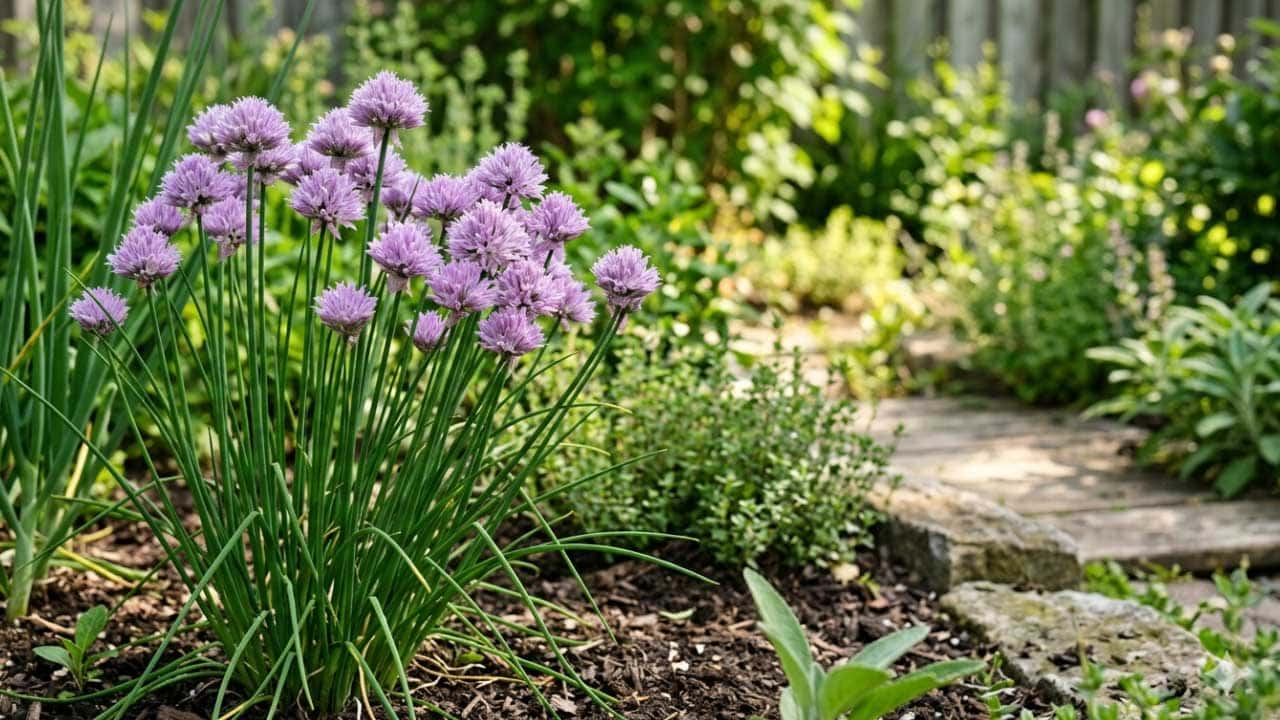
Which herbs like sun? Which annuals? Or a perennial? Can it be grown in containers? Get answers to these beginner questions to get started growing herbs outdoors.
If you want to grow them indoors, see How to Grow Herbs Indoors (Beginner’s Guide).
Growing herbs outdoors: tips for beginners

These tips will help you get started growing herbs in containers outdoors or in flower beds in your garden. The first step is knowing which plants are annuals or perennials, and then knowing the optimal growing conditions for each variety.
This advice is intended for gardeners growing in cold regions of the United States and Canada (hardiness zones 4 through 8), but much of it is universal.
Let’s take a closer look at what herbs are, the different types, and how to grow them.
Get your free printable
This article has free printables.
Visit the resources (below) to get them.
1What are herbs?
Herbs are obtained from the leaves and green parts of plants, while spices are obtained from roots, bulbs, stems, bark, and seeds.
Plants classified as herbs can be used for food (culinary), flavor, aroma, color, or medicinal purposes. Some are powerful, while others are harmful.
We tend to include some spices (plant-based) under the herbal umbrella and have included a few here as well.
What are herbaceous plants?
Herbaceous plants (by definition) are flowering perennials that do not develop woody stems. Many herbs are herbaceous plants, but not all. Rosemary and lavender both develop woody stems, so by this definition they are not herbaceous, but are herbs. It’s just one of those weird things in the English language.
2What is the difference between annual herbs, biennial herbs, and perennial herbs?
Herbs can be annuals, biennials, or perennials.
Annuals are plants that germinate, flower, produce, set seed, and die within one year. These include many flowers, herbs, and vegetables. Basil is an example of an annual plant. The biological cycle of biennial plants is two years. Leaves grow in the first year, flowers bloom, seeds, and withers in the second year. Parsley is one example, but we grow it as an annual. Perennials are plants that live for several years. It can bloom or fruit every year. Lemon balm and mint are two examples.
A detailed list is provided below.
3Which herbs are annuals?
annual grass
Annual herbs germinate, flower, fruit, set seed, and die within one year.
Basil, sweet | Foto Basil, sweet Ocimum basicum
Uses: Borage leaves | Borago offininalis – Spring herb
Use: Flower Caraway | Umbelliferae
Uses: Fruits and Seeds Cardamom |Elettaria Cardamom
Uses: Seed pod chamomile, German | Matricaria chamomile
Uses: Flowers (daisy-like) Coriander Coriander | Coriandrum sativum – Seeds readily (tends to bolt) Coriander – leaves and stems Coriander – seeds
Recommended: Vietnamese coriander is one of the easiest coriander varieties to grow. Chervil | Anthriscus cereifolium – perennial grown as an annual
Use: leaf
A relative of parsley, it can survive in dark places. Cutting celery | Apium graveolens – a perennial grown as an annual plant
Uses: Dill leaves | Anethum graveolens
Uses: Leaves and Seeds Fennel | Foeniculum vulgare – Grown as an annual vegetable for bulbs, which flower to give seeds. Hyssops officinalis
Herb Lemongrass | Medicinal Herb Cymbopogon citratus – Tropical Plant for Zones 9-10
Use: petiole
Start with the stems you bought at the grocery store. Cut off the top and grow in a few inches of water. Parsley | Petroselinum Chrisum, Petroselinum hortense – grown as an annual every other year
Uses: Leaves, summer savory |Saturya hortensis
Use: leaf
4Which herbs are perennials?
Perennial
Perennials are plants that live for several years. It can bloom or fruit every year.
Alexander | Smyrnium olusatrum – Biennial – Zones 5 to 9
Uses: Leaves, shoots, roots, flowers, seeds Anise Hyssop | Agastache – Zones 4a to 9b
Uses: Leaf (Lamiaceae) Laurel | Laurus nobilis – Tender perennial – Zones 8-11
Uses: Chamomile leaf, Roman leaf | Chamaemelum nobile – Zones 3 to 9
Use: Essential oil Allium schoenoprasum – Zones 3 to 9
Uses: Foliage and Flowers Fennel | Foeniculum vulgare – Zones 6 to 10
Uses: Leaf and Seed Chive | Allium tuberosum – slow growing, starts from seed – Zones 3 to 10
Uses: Foliage and Flowers Lavender |Lavender – Prefers slightly sandy alkaline loam soils – Zones 5 to 9
Uses: Flowers Lemon Verbena | Alaysia triphylla – Tender Perennial – Zones 9-10
Uses: Lemon Balm Leaves | Melissa officinalis – Invasion Zones 4-9
Use: Lovage leaves | Levisticum officinale – Zones 4 to 8
Uses: Roots, Seeds, Leaves Marjoram, Sweet | Origanum Majorana -*Tender Perennial – Zones 9-10
Uses: Mint Leaf | Mentha – Invasive – Grows underground or in containers above ground – Zones 4 to 9
Uses: Oregano leaves | Origanum – Zones 4 to 8
Uses: Rosemary Leaves | Salvia Rosemarinus, formerly Rosemarinus officinalis – Tender Perennial – Zones 6 to 9
Uses: Sage leaves | Salvia officinalis – Zones 5 to 9
Uses: Shepard leaves | Capsella bursa pastoris – Zones 4-7 Sorrel | Rumex shoulder – Zones 3-9
Uses: Sweet Woodruff Leaves |Gallium Odoratum* – Zones 4 to 8
Uses: Flowers and green leaves to flavor drinks
*Warning: Considered invasive in some areas. Wild ginger Asarum canadens is often recommended as an alternative. Tarragon, France | Artemisia dracunculus – Zones 4 to 8
Uses: Twig Thyme | Foeniculum vulgare, Thymus vulgaris – Many varieties – Zones 5 to 9
Uses: Leaves and Seeds Valerian | Valerian officinalis – Zones 4 to 9
Uses: Winter Savory Leaves | Satsuleja montana – Zones 5 to 8
Uses: Stems, Leaves Yerba Buena | Satureja douglasii – Lamiaceae – Zones 7 to 10
Use: leaf
5What are the different ways to propagate herbs?
Herbs can be grown from seeds, cuttings, or by dividing existing plants.
While some herbs are easy to grow from seed, others, such as basil, are less reliable. Some herbs, such as rosemary and lavender, can be easily propagated by cuttings.
One of several ways to propagate by cuttings: Cut a 4- to 6-inch stem. Remove the bottom leaves. Plant in lightly moistened potting mix, placing the stem inside the pot. Place in indirect light at 70°F (21°C) or slightly warmer to keep moist.
This tutorial details how to grow plants from cuttings.
The easiest way to start is to buy established plants from a nursery and consider different ways to propagate them to get more (free) plants as they grow and become established.
6How much sunlight do herbs need?
herbal solar chart

Optimal growing conditions, including the amount of sun, will vary depending on the plant and the strength of the growing conditions.
In general, most herbs prefer well-drained soil, don’t tolerate humid conditions, enjoy plenty of sunlight (at least 5 hours per day without drying out in the heat), and grow just fine in containers. Specific needs vary by species. Many herbs do well in partial shade. Growth will be slower, but it will avoid drying out in the hot summer sun.
Here we discuss full sun, partial sun, partial shade, and shade, and give tips for evaluating light in your garden.
7Can I grow herbs in containers?
Yes, all herbs can be grown in containers.
Use a lightweight potting mix to ensure good drainage. Most herbs originate from Mediterranean growing environments and generally prefer poor soils, as they do not require extra nutrients. Stand the pot on a stone so that it is not resting on a saucer of water. Using separate containers for each plant makes it easy to move the plants or bring them indoors for overwintering if necessary.
8What fertilizer should I use for herbs?
Before fertilizing, find out what your soil or growing medium already provides. Many herbs don’t require that much, so you may already have what you need.
If you absolutely need to fertilize, granular organic fertilizer is also an option. Look for organic products that are safe for food crops and are intended for growing foliage (foliage) rather than flowers. This guide to organic fertilizers has more information. We only use homemade compost.
9When should I harvest herbs?
The best time to harvest herbs depends on what you’re growing and what parts of the plant you want to use.
For herbs used for stems and leaves, regular harvesting (no more than 1/3 of the plant) will encourage new growth. These can be eaten anytime. Removing emerging flowers can delay the seed production phase that marks the end of a plant’s life. For flowers and extracted oil, wait until the flowers mature. Seeds are produced after flowering but must mature to survive.
10How do you store herbs?
How to dry herbs
Herbs can be used fresh or dried depending on the type and purpose.
Tie the stems together (but with good ventilation) and hang them indoors or under a covered porch until completely dry (this may take up to 6 weeks). Microwave drying: Place in the microwave in a single layer on a paper towel and heat on low for 30 seconds. Check by turning it over every 30 seconds until completely dry.
Also see How to Harvest and Dry Herbs for Cooking and Herbal Teas for more tips.
Preserving, freezing, and infusing herbs
Store dried herbs in an airtight container. This tells you how long your household herbs and spices will last.
You can also freeze the herbs whole or in ice cube trays with oil.
infused oil and honey
Place the dried herbs in a jar and pour in the olive oil. After 6 weeks, strain the oil. The herb flavor remains strong. You can do the same thing with honey, but it’s not as easy to puree.
11How do you make homemade herbal tea?
How to make herbal tea depends on which part of the plant is used. This includes leaves, flowers, fruits, seeds, and roots.
This article on 60 Plants to Grow for Homemade Herbal Tea lists a variety of tea plants and additional resources to get started.
resource
Epress of Dirt
List of perennial and annual herbs
A plant list for this article is also included.
A download link will be sent to your email.
Joining our free newsletter list is an option at checkout.
Seed mail order
ebook

Seed start for beginners
Sow seeds inside, grow outside
Written by Melissa J. Will
We have everything you need to start indoor seeds for indoor and outdoor plants. Grow whatever you want any time of the year.
PayPal, credit card, Apple Pay
This eBook is a digital file (in PDF format) that is saved on your device. It’s not a physical product.
About this ebook |Visit the ebook shop
~Melissa Empress of Dirt ♛