Thanks to a surprising flaw in human psychology, adding healthier options can actually push people to make even worse choices.
In 2017, with much fanfare, national chain restaurants began requiring calorie display on their menus. Consumers should have the information they need to make healthy food choices outside of the home, right? It stands to reason that calorie information on menus can help people limit their dietary intake to stay within their daily energy needs. But it didn’t work. Calorie labeling was found to be ineffective, with a meager calorie reduction of an average of 8 calories per serving.
That would have been completely predictable. why? Just as we can infer their value from the industry’s furious reaction to front-of-pack traffic light labels, we might also assess the futility of calorie labeling by the ease with which some regulations were passed. McDonald’s began voluntarily publishing calorie information nationally in 2012 after New York City’s labeling requirements were found to have no overall impact on consumer behavior. Research suggests that such labeling may increase “perceptions that restaurants care about consumers’ health,” while being careful not to dilute the Big Mac attack.
At the same time, McDonald’s announced plans to add seasonal ingredients to its menu. How ironic is it that we don’t at least recognize that as a good thing? Ironically, adding healthier options may actually encourage people to make worse choices. Are you ready to be surprised?
As I explain in my video “Do Healthy Fast-Food Options Lead to Healthy Choices?”, when people are offered a choice of side dishes, whether it’s something unhealthy like fries or something more neutral like a baked potato, only about 10% of people will splurge on fries. If a third, healthier option is added, like a side salad, instead of choosing between an indulgent option and a more neutral baked potato, people will choose between an indulgent option, a neutral option, or a healthier option. Even if not everyone chooses a salad, more people will choose a plain baked potato over fries, right? So how much does adding a salad option to the mix broaden the flavor of your fries? That jumps, tripling to 33%. Without the salad option, only one in 10 people would have chosen fries, but that number jumped by a third when they saw the salad.
The same thing happens when you give people a choice between a bacon cheeseburger, a chicken sandwich, or a veggie burger. In the “no healthy options” scenario, people were offered a cheeseburger, chicken sandwich, or fish sandwich, and 17% chose the burger. Replacing the fish sandwich with a veggie burger doubled the preference for the bacon cheeseburger to 37%. How can just seeing healthy options lead people to make more unhealthy choices?
The paper describing this series of experiments was titled “Vicarious Goal Attainment: When the Mere Presence of Healthy Options Ironically Leads to Extravagant Decisions.” The idea is that people who see a salad or veggie burger make a mental note to vaguely choose it next time, thereby giving them an excuse to splurge now.
There is an interesting flaw in human psychology called self-licensing. This is when you subconsciously justify doing something that moves you away from your goal, right after you do something that moves you towards your goal, such as justifying eating a donut because you lost weight last week. We treat ourselves to the luxury of being able to go back.
If you give smokers a “vitamin C” supplement, they will subsequently smoke more cigarettes than if you gave them the “placebo” tablets you describe (despite giving both groups the same sugar tablets). Smokers who thought they were taking supplements ended up smoking nearly twice as much, but perhaps subconsciously thought that because they had just done something good for their health, they would “live a little longer,” and as a result may have shortened their lifespan a little.
You can see how this can be applied to other lifestyle areas. The participants who received the placebo tablets, believing it to be a nutritional supplement, not only had less motivation to exercise afterwards, but also walked about a third less afterward. Additionally, compared to participants who were told the pill was a placebo, those who were misinformed were more likely to choose the buffet over a purported “healthy, organic meal.” Will they eat more too? A seminal study entitled “The Liberating Effects of Weight Loss Supplements on Dietary Management” proved just that.
Participants were randomly assigned to receive either a known placebo or a weight loss supplement (which was actually the same placebo) and were then secretly observed at a buffet. Not only did the “supplement” subjects eat more food, but they also chose less healthy items. They also ate about 30% more candy and ordered more sugary drinks in a fake “taste test.” “Thus, people who rely on nutritional supplements to protect their health may pay a hidden price: the curse of sanctioned complacency,” the researchers concluded.
Returning to the topic, what research on goal achievement surrogacy has found is that not only does moving toward a goal rationalize decisions that harm us, but just considering moving forward can have a similar licensing effect. Note that study participants were not only moved to make more unhealthy choices, they were also driven to make the least healthy choices. One might think that even if people did not choose the salad or vegetable option, the presence of healthier alternatives might have encouraged them to choose something in between, something that might not be the healthiest option, but at least not the unhealthy one. Rather, it moved people in the opposite direction.
In a separate “no healthy option” scenario of chocolate-covered Oreos, regular Oreos, or golden Oreos, researchers found that adding a “low-calorie” Oreo option doubled the likelihood that study participants would directly choose the most indulgent chocolate-covered option. (See below and at 6:10 of my video.)
This is thought to be due to another illogical quirk of human psychology, and has been inappropriately named “What the Hell Effect.” This is when one forbidden cookie could cause a dieter to eat the entire bag. If you’ve already strayed from your goal, why not try going all the way? So next time you decide to eat that salad and pamper yourself just this time, you might as well make the most indulgent choice.
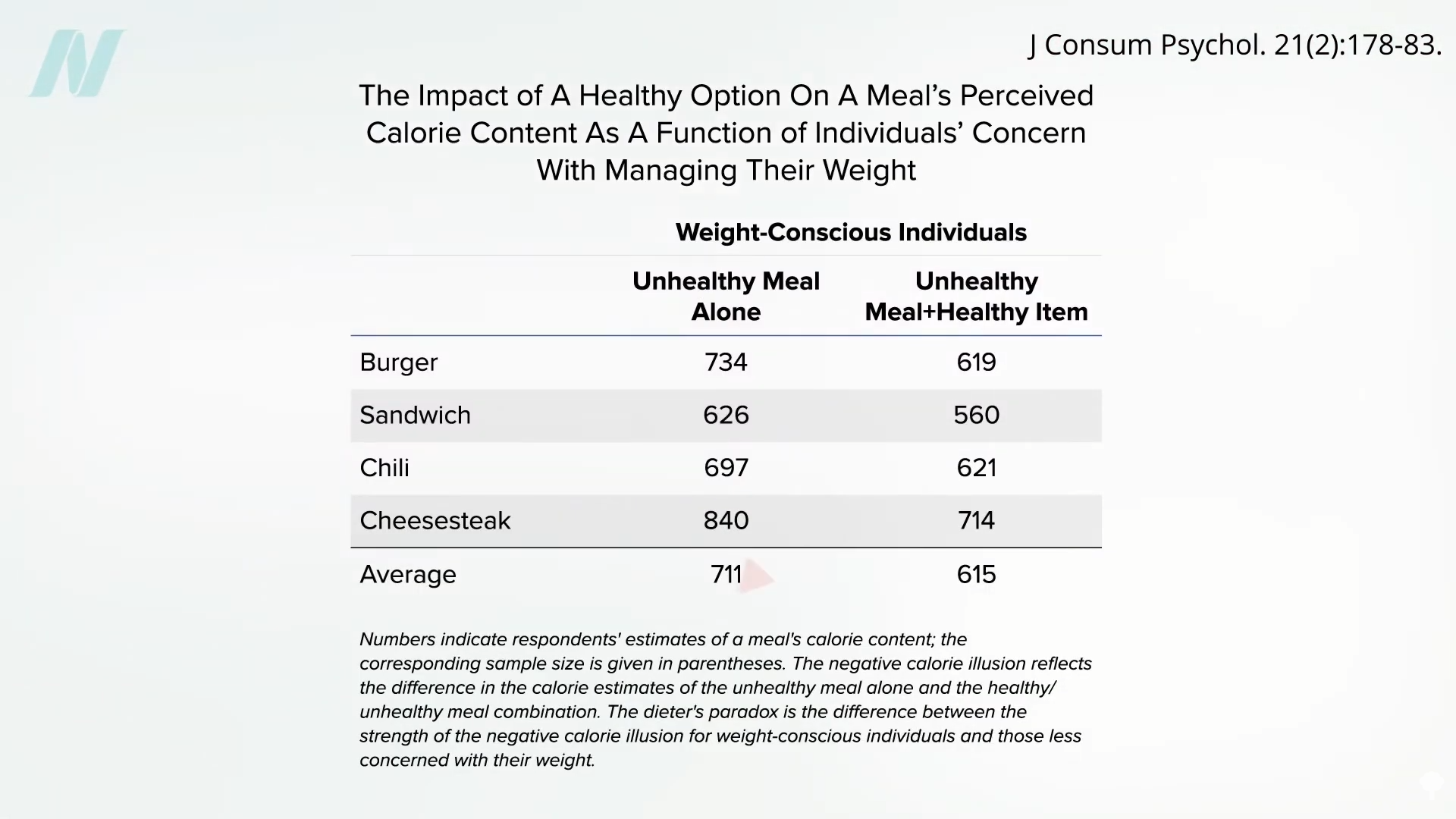
The light of healthy food can even distort our perception. Show someone who is watching their weight just a hamburger and ask them to estimate the calories. The average answer is 734 calories. Now, if you show people the exact same burger with three celery sticks, you would expect the total to be 619 calories. Did they think celery had negative calories? No, most people knew that celery also has calories, but just juxtaposing celery with a burger made the burger seem healthier. The same thing happens if you add an apple to your bacon and cheese waffle sandwich, a side salad of beef chili, or carrots on the side of your cheesesteak. As shown here and in my video at 7:27, it seems like about 100 calories disappear.
The health halo effect may explain why people were more likely to order dessert and more sugary drinks with Subway’s “healthier” Subway than with McDonald’s Big Mac, even though the Subway used in the study (with ham, salami, and pepperoni) had 50% more calories to begin with.
Just referring to healthy foods can be effective. If you show people a picture of a Big Mac, they will estimate that it has 646 calories. Just add the text “Eat at least 5 fruits and vegetables per day for good health” and suddenly the same burger in the same ad seems to only have 503 calories. By simply serving and promoting salads and fruit, McDonald’s can bring praise and increase consumer loyalty, ironically without helping health.
doctor’s note
If you like this blog, you might also like the video I made about optimism bias: “Why don’t people eat healthy?”
For more information on junk food, see How we won the battle to ban trans fat and ultra-processed junk food testing.