“One useful word brings more peace to hearing than a thousand useless words.” ~Buddha, Dhammapada
Did he just cut the side of my head open? Is it bleeding from everywhere? Is the blood running from my face onto the floor?
It was in the middle of a standard bi-weekly haircut when my mind suddenly started swirling.
I felt a slight pain in the side of my head, anxiety took over, and I used my vivid imagination to reorient myself to the worst-case scenario.
Not too long ago, my barber and I were laughing about Disneyland. After a few seconds, I was convinced he had accidentally cut my head open and everyone in the store watched silently as I bled out.
One of his fellow barbers brought me trail mix and water, but inside I felt trapped in a relentless loop, cycling between anxiety and fear, unable to break free.
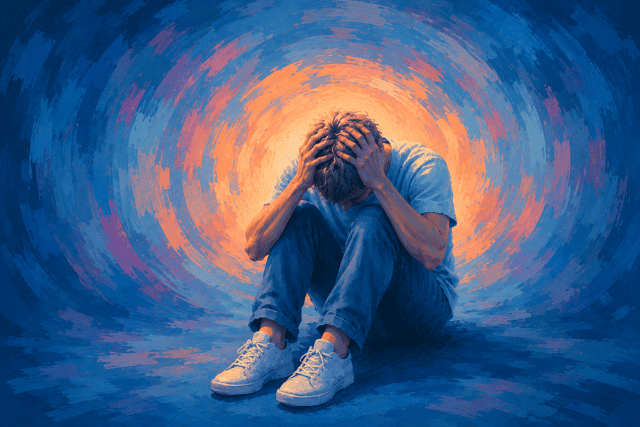
My voice became muffled. The clippers sounded like they were miles away. It felt like my mind was no longer inside my body. I was floating somewhere above it, watching myself explode at the same time.
“Call 911!” I yelled. Despite being in my early 30s and perfectly healthy, I was convinced I was having a heart attack. All rational thought disappeared as the physical symptoms overwhelmed me. My chest tightened, my vision blurred, and I knew this was it.
“Am I going to die?” I asked, regretting not writing a will.
I jumped off the barber’s chair and lay on the floor, bracing myself for a sure-fire heart attack. Even though I knew I was going to need CPR, I somehow still had the strength to pull out my wallet, find my insurance card, and throw it to the ground in case I was rushed to the hospital.
It’s been about 10 years since I was diagnosed with post-traumatic stress disorder and generalized anxiety disorder. Since then, I’ve tried hard to manage my mental health through therapy, medication, and self-care, but panic is a very sneaky way to catch people off guard.
The last time I had a panic attack was a few months ago and I told myself I would be fine. Obviously, that wasn’t the case.
“What do I look like? Is my hair only half cut?” was the first question out of my mouth as I lay sprawled out on the cold cement floor, covered in hair and shame, as fire engine sirens approached.
My barber crouched down next to me. He remained calm. He gently told me to breathe and reminded me that I was probably having a panic attack.
As I slowly began to calm down, my perception changed from floating above me to landing slightly behind my body. My chest still hurt, but the feeling in my hands was returning.
When the paramedics arrived, a wave of embarrassment washed over me. I started to realize that no, I wasn’t having a heart attack. No, he wasn’t dead. No, I wasn’t in hell. I had just had a panic attack.
The only thing that died that day was my little pride. Six firefighters surrounded me in a small barbershop while I lay sweating on the ground.
They checked my heart rate and blood pressure. Both rose.
Then the real key point is: “Do you have any pre-existing conditions?”
I explained that I live with anxiety and panic attacks. One of the firefighters sighed and several others turned to the truck. It devastated me.
Despite being a vocal advocate for mental health, I felt ridiculously small, like the kid who cried wolf, except the wolf was invisible to everyone but me. It was a raw shame that I didn’t expect and didn’t really know how to deal with. It was like all the things I had been advocating for all these years suddenly disappeared through a glass window in the face of the impatience of the people at the barbershop.
Her sigh was not only filled with regret. What stung deeper than any physical symptoms was ignoring what I was actually experiencing.
The one remaining firefighter asked about my current medications, sighing loudly every time I listed my prescriptions, as if my fear was a personal nuisance. I felt like he was irritated by my very presence because he genuinely feared for my life.
Once a heart attack was ruled out, the remaining firefighters helped me into a chair and left.
As I sat down with my hair cut in half, I couldn’t help but think about how common this experience is. According to the National Alliance on Mental Illness, more than 1 in 5 U.S. adults live with a mental illness each year. Millions of us are dealing with something invisible. Yet here I was, filled with shame for something I had no control over.
Then my barber did the most ordinary, yet very unusual thing.
“Are you okay, brother?” he asked. Then he picked up the clippers and continued to casually cut my hair as if nothing had happened, and we resumed our conversation about Disneyland, as if I hadn’t just had a near-death experience on the floor next to him.
He didn’t pity me. He didn’t criticize me. He didn’t take care of it. He was just calm and his calmness taught me that I was still me.
That was it.
This is what I’ve learned after years of living with panic attacks. You can’t logically think your way out of it, and no one can logically think your way out of it.
When that’s happening, the part of my brain that knows I’m safe gets quiet. Logic doesn’t hold up and facts don’t help.
When someone insists, “You’re fine,” it often makes things even worse. I feel like there’s one more person who doesn’t understand.
What actually helps is presence. That means a steady voice or a calm body next to me.
My barber had no training in this. He just stayed calm when I couldn’t. It brought me back to my room when I couldn’t do anything else.
I have a dedicated tool and use it regularly. One is the 5-4-3-2-1 grounding exercise. Here are five things you can see, four things you can touch, three things you can hear, two things you can smell, and one thing you can taste. The process brings me back to the present.
I also use a small handheld device called a TheraTapper. Sends gentle pulses to your left and right hands to help calm your nervous system during races.
These tools work, but honestly, in the worst case scenario, you don’t always have access to them.
Lying on the barbershop floor, convinced he’s going to die, his thinking power is offline. This is precisely when the composure of others becomes most important. The tools to practice in silence are mine, but stability often has to come from someone else.
I’m sharing this because panic attacks are often invisible until they suddenly disappear. Shaking, crying, and lying on the floor may seem dramatic, but most of the suffering happens out of sight.
And when it comes into view, the reactions of those nearby can make all the difference, whether it’s a sigh, a shrug, or a simple “Are you okay?”
I’ll never forget the firefighter’s sigh, but I think about the barber much more often.
Even without saying those words, he reminded me that I wasn’t crazy, I wasn’t broken, and I wasn’t alone. Sometimes the most healing thing isn’t advice or reassurance. It’s someone who will stay quietly next to you until you find your way home.

About Kyle Elliott
Dr. Kyle Elliott (he/him/him) is a career and executive coach for technology leaders. As a queer person living with a mental health condition, he takes pride in using his voice and platform to help others share their stories, get help, and achieve recovery. Download his free self-care guide and discover over 30 quick, practical strategies to reduce stress, strengthen your mental health, and reclaim your time and energy.